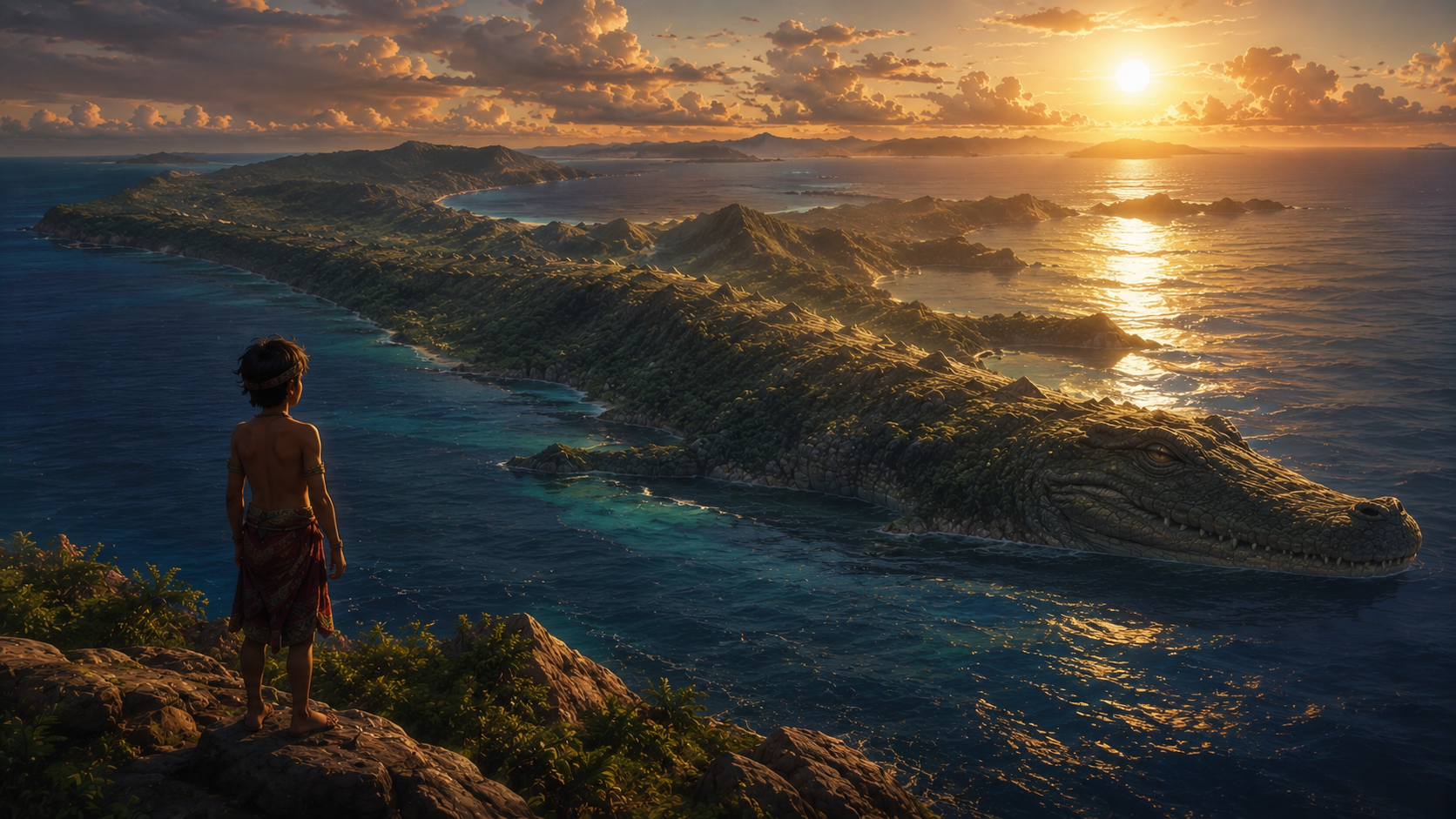
Long before maps, borders, and modern nations, the Timor-Leste crocodile legend told a story about a creature that shaped their entire world.
It was not a god.
It was not a king.
It was a crocodile.
To outsiders, the Timor-Leste crocodile legend might sound like a simple myth. But for generations of Timorese people, the crocodile is more than just an animal. It is a sacred ancestor, a protector, and the very spirit of the land itself.
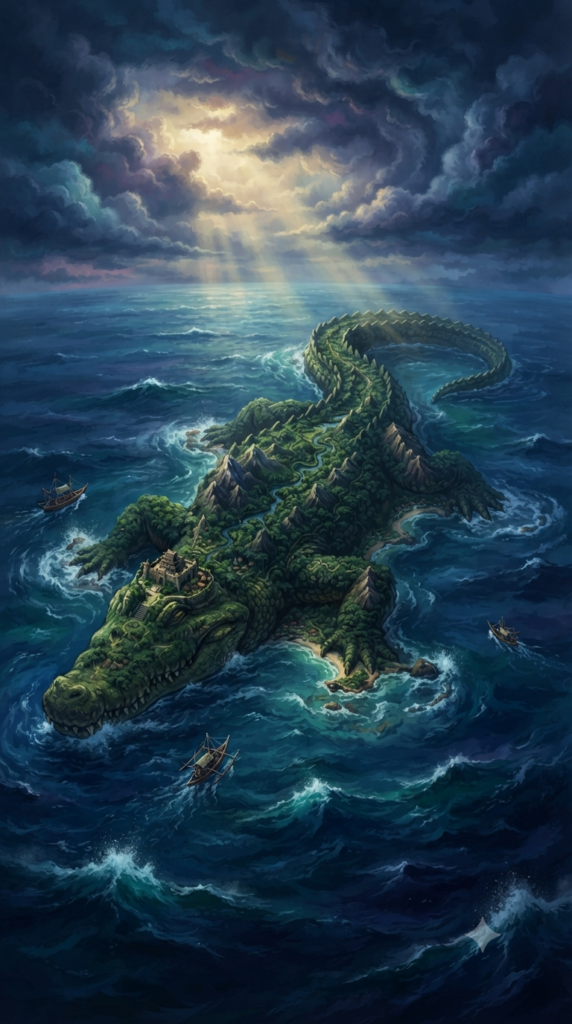
According to legend, the island of Timor, long, curved, and rugged is not just land. It is the body of a great crocodile, forever resting in the sea after a journey that changed both its fate and the fate of a young boy.
This is the story of how an island was born from a living being.
The Boy and the Crocodile
The story begins with a lonely boy standing by the sea.
In some versions of the tale, he is a young child wandering along the shoreline, curious about the vast ocean before him. In others, he is lost, searching for something more than the life he knows.
One day, he notices something unusual in the water, a small crocodile, weak and struggling. It is not fierce or threatening. It is helpless.
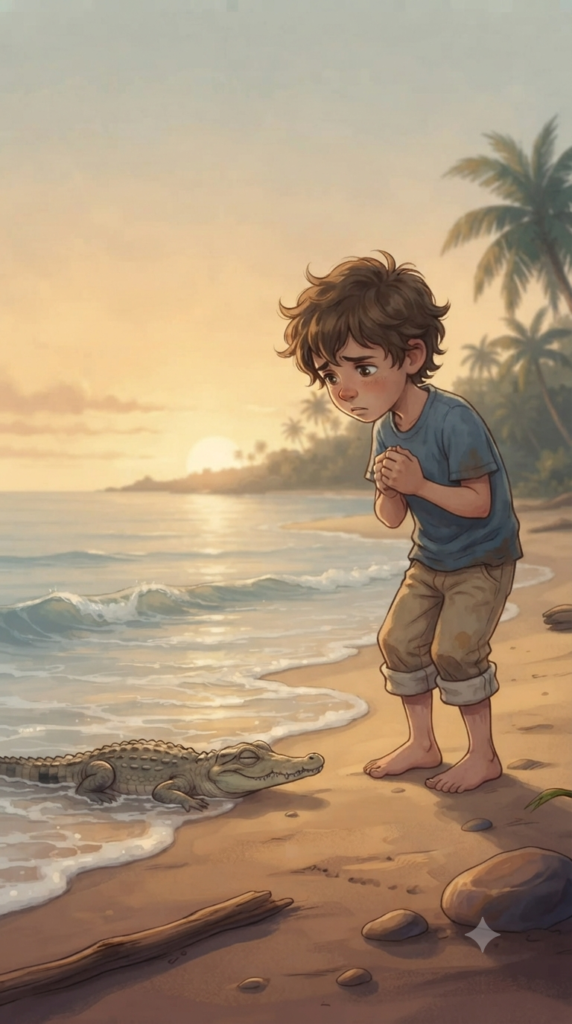
Moved by compassion, the boy does something unexpected.
He saves it.
He carries the crocodile to safety, protects it, and nurses it back to strength. Over time, an unlikely friendship forms between the two. The boy trusts the creature, and the crocodile, in return, shows gratitude.
But this is no ordinary crocodile.
The Promise of the Sea
As the crocodile grows stronger, it reveals that it is old, older than the boy can imagine, and that it carries a deep longing.
It wants to see the world.
In many versions of the legend, the crocodile speaks to the boy, offering him a choice:
“If you help me return to the sea, I will take you on a journey across the world.”
The boy agrees.
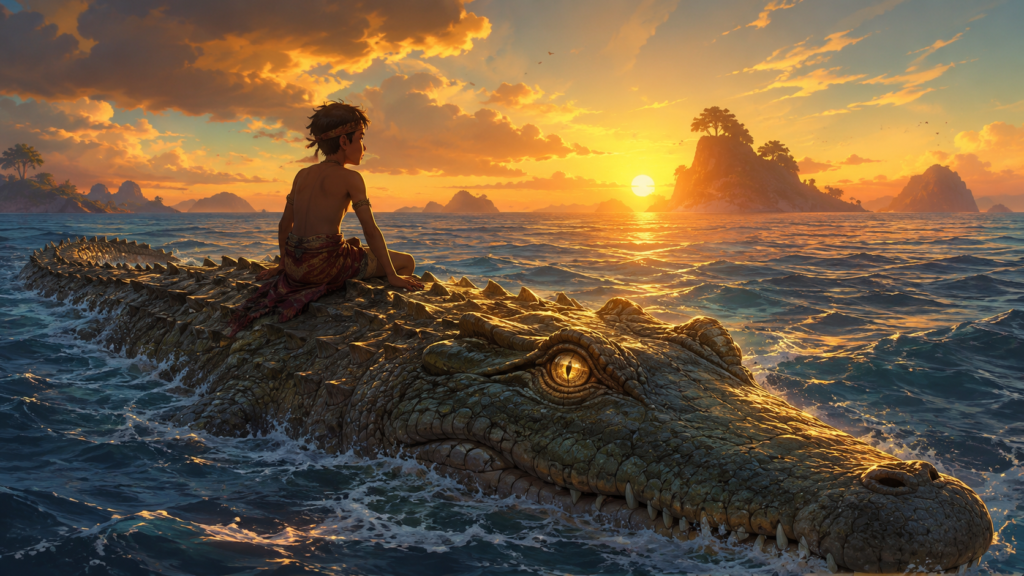
He climbs onto the crocodile’s back, and together, they begin a journey across the ocean. They travel far beyond the familiar coastline, passing distant lands, exploring unknown waters, and witnessing the vastness of the world.
For the boy, it is an adventure unlike anything he has ever known.
For the crocodile, it is a final pilgrimage.
The Transformation
Years pass.
The crocodile grows old, and the time comes when it can travel no more.
Before it dies, it makes one final promise to the boy, a promise that will transform everything.
“I will become your home.”
As the crocodile breathes its last, its body begins to change.
Its back rises and hardens into mountains.
Its ridges become hills.
Its scales transform into forests and valleys.
Its long, curved body becomes the shape of an island stretching across the sea.
This island becomes Timor.
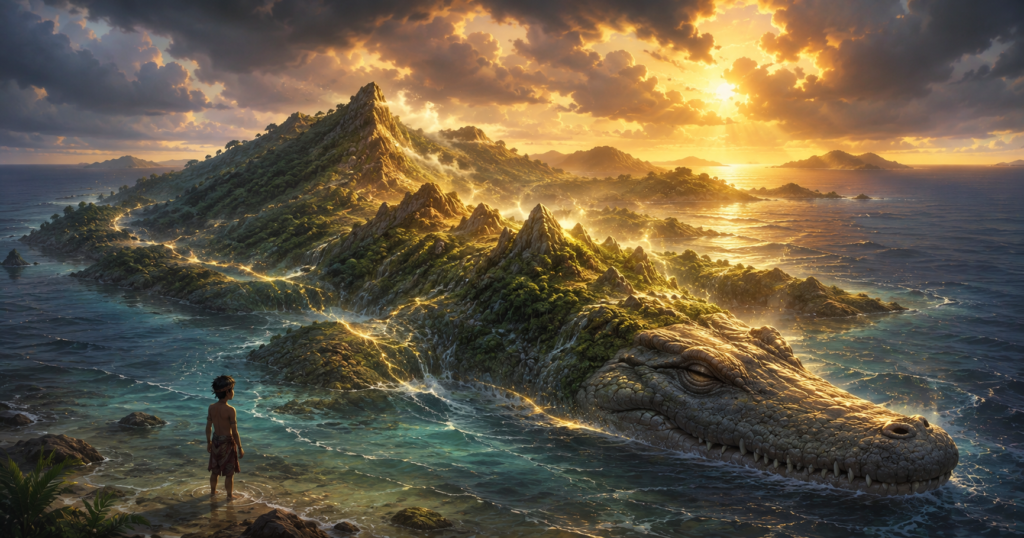
The boy, no longer alone, now has a home born from friendship, sacrifice, and the bond between human and beast.
Why Timor Looks Like a Crocodile
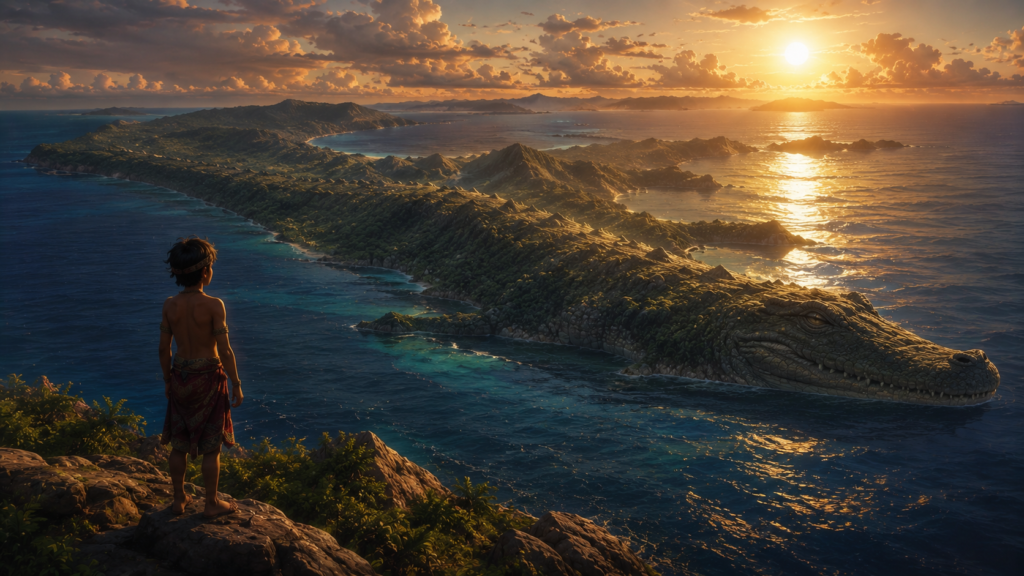
Look closely at a map of Timor-Leste, and you will notice something remarkable.
The island curves like a reptile.
The mountainous ridges resemble the back of a giant creature.
The shape stretches long and narrow, like a crocodile resting in the water.
For the people of Timor-Leste, this is not coincidence.
It is proof of the Timor-Leste crocodile legend.
The island itself is known as “Lafaek” in local tradition, meaning crocodile. Even today, the crocodile is seen not as a dangerous predator, but as a sacred being, a protector, and an ancestor. The bond between people and crocodile is deeply rooted in cultural identity.
The Crocodile as Ancestor and Protector
Unlike in many parts of the world where crocodiles are feared as deadly animals, in Timor-Leste they are often respected.
Killing a crocodile is traditionally taboo in many communities. Some believe that harming one can bring bad luck or spiritual consequences. Others see the crocodile as a guardian of the land and sea.
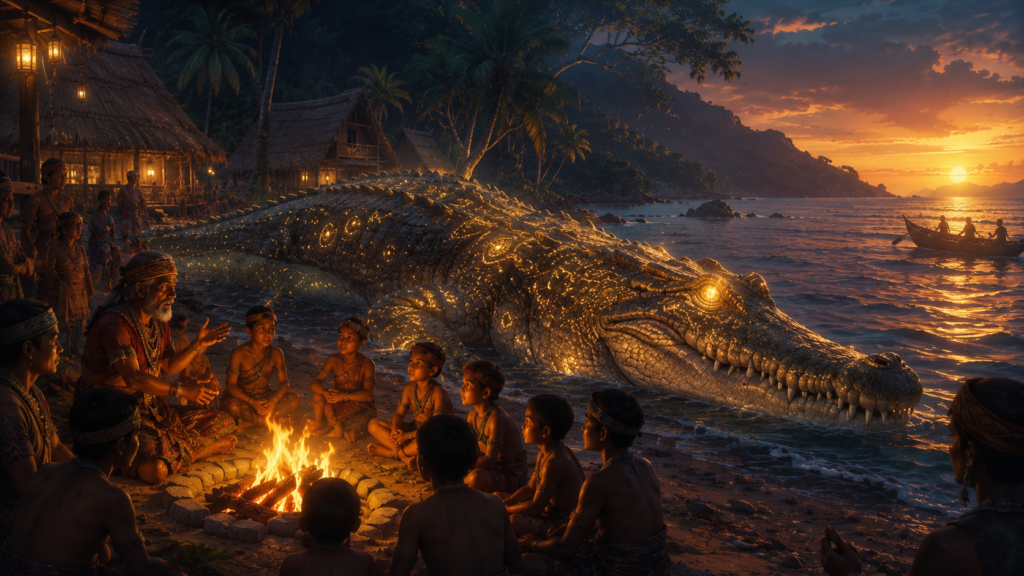
In certain villages, stories are still told about crocodiles that recognise specific families or protect certain areas. They are not merely wildlife, they are part of a living tradition.
This belief reflects an important idea:
The crocodile is not separate from the people.
It is connected to them.
In this way, the legend is not just about how the island was formed. It is about identity, belonging, and the relationship between humans and nature.
Why This Legend Still Captivates the World
In a world filled with modern explanations and scientific maps, the crocodile legend stands out for its simplicity and emotional power.
It doesn’t rely on complex gods or distant cosmic battles.
Instead, it offers something more human:
A boy.
A creature in need.
A journey.
A promise.
And an ending that transforms loss into something permanent and beautiful.
This is why the story continues to spread beyond Timor-Leste. It resonates with anyone who understands the idea that small actions can have lasting consequences.
And perhaps, when we look at the shape of the island from above, we are not just seeing geography.
We are seeing a story that refused to disappear.
Follow us on TikTok.
If you are interested in this story of the Timor-Leste crocodile legend, also read Bakunawa and the Seven Moons: The Forgotten Horror Hidden in the Ancient Philippine Sky
Leave a Reply