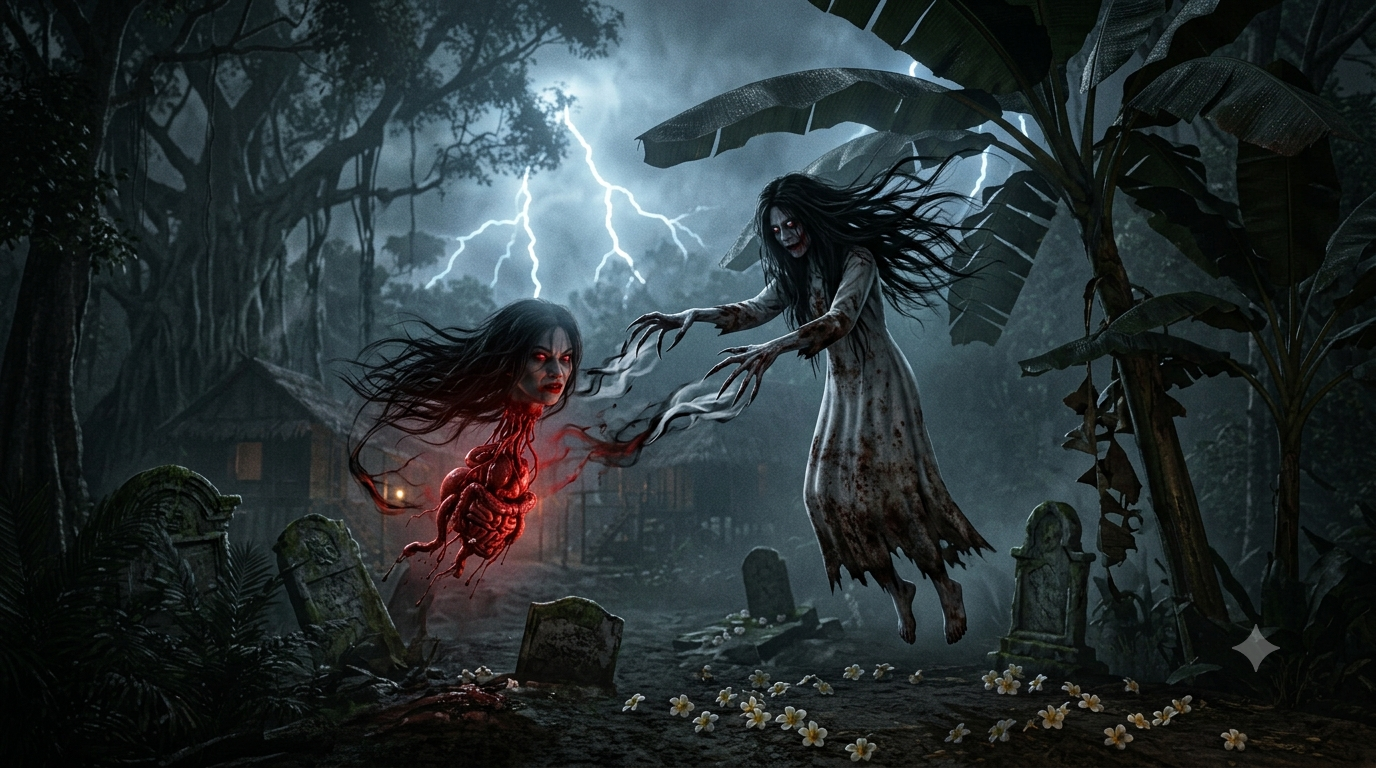
Penanggalan vs Pontianak is a comparison you might have heard of.
In the dark corners of Southeast Asian folklore, not every ghost waits quietly beneath a tree or wanders through an abandoned road.
Some fly.
Some scream.
And some arrive with the face of a beautiful woman, only to reveal something far more horrifying when it is already too late.
Among the most feared female supernatural beings in Malay and Indonesian folklore are the Penanggalan and the Pontianak, also known in Indonesia as the Kuntilanak. At first glance, people often confuse them. Both are associated with women, blood, night, childbirth, death, and terror. Both are said to haunt villages, roads, forests, and lonely houses. Both have become part of the wider horror imagination of Malaysia, Indonesia, Brunei, Singapore, and the southern Philippines.
But they are not the same.
The Penanggalan is often described as a flying, detached female head with her internal organs trailing beneath her. The Pontianak, on the other hand, is usually known as the restless spirit of a woman who died tragically, often linked to pregnancy or childbirth, returning as a beautiful but deadly ghost. Southeast Asian folklore sources commonly distinguish the Penanggalan from the Pontianak/Kuntilanak in appearance, origin, and behaviour, even though both occupy the same terrifying world of regional female spirits.
So, what exactly is the difference between Penanggalan and Pontianak? Let us step carefully into the night.
What is a Penanggalan?
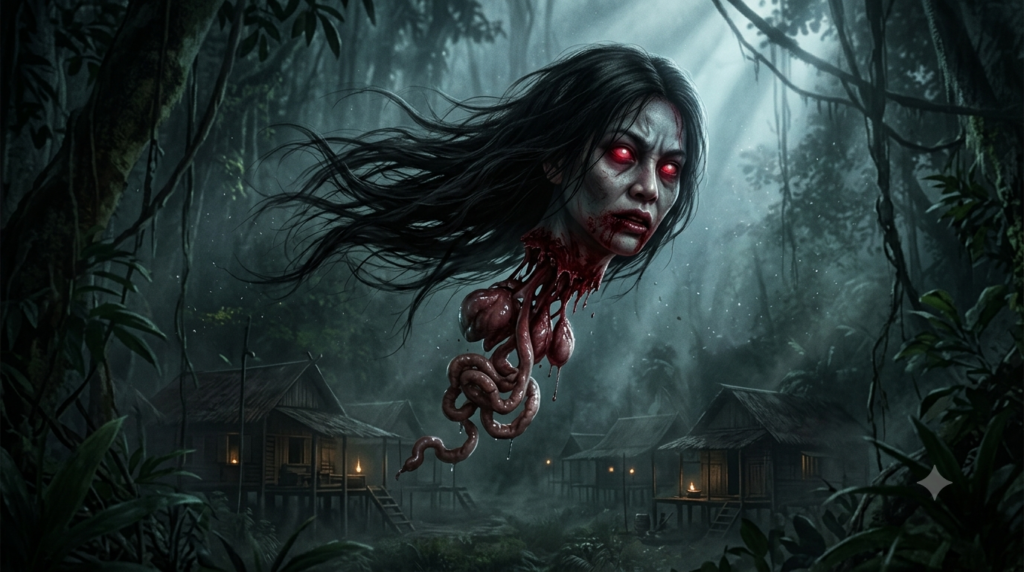
The Penanggalan is one of the most visually disturbing creatures in Southeast Asian folklore.
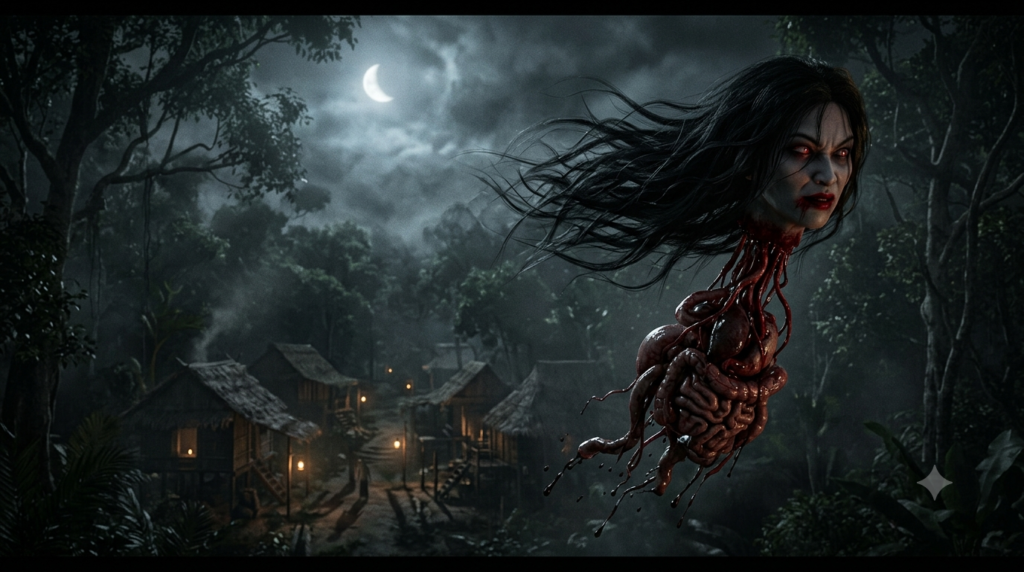
By day, she may appear to be an ordinary woman. She may live among villagers, speak normally, and hide her true nature from everyone around her. But at night, according to legend, her head detaches from her body and flies through the darkness, with lungs, stomach, intestines, and other organs hanging below like wet, glistening roots.
Read 4 Chilling Hidden Realities Behind The Penanggalan Legend in Southeast Asia!
This is what makes the Penanggalan so unforgettable.
She is not merely a ghost. She is a living horror that separates from herself.
In many Malay traditions, the Penanggalan is associated with dark magic, forbidden knowledge, or a woman who gained supernatural power through occult practices. Some stories describe her as a midwife, sorceress, or woman who made a pact to obtain beauty, strength, or mystical ability. The cost of this power is monstrous: at night, her head leaves her body to hunt.
Her victims are often newborn babies, pregnant women, or people weakened by illness. This connection to childbirth and vulnerability makes her especially frightening in village folklore. The fear is not only that she kills, but that she enters the most intimate and protected spaces of human life: the home, the birth room, the sleeping body. The Penanggalan belongs to the wider family of Southeast Asian flying female horrors, similar in theme to other regional beings such as the Manananggal of the Philippines and the Leyak of Bali. These beings reflect a recurring regional fear of bodies that transform, separate, fly, and feed under cover of darkness.
What Does a Penanggalan Look Like?
A Penanggalan is usually imagined as:
- A woman’s head flying through the night.
- Long hair streaming behind her
- Internal organs hanging below the neck
- A glowing or eerie presence in the dark
- A creature that may smell of vinegar, blood, or decay in some versions
- A being that returns to its hidden body before sunrise
One of the most famous details in Penanggalan folklore is that she must return to her body before daylight. In some versions, her dangling organs swell after feeding, so she must soak them in vinegar to shrink them before fitting back into her body.
This detail makes the Penanggalan uniquely grotesque. She is not only frightening because she attacks people, but because her entire existence feels unnatural. Her body is divided. Her humanity is split between ordinary daylight and monstrous night.
That is why she remains one of the most memorable beings in Malay horror.
What is a Pontianak?
The Pontianak is a different kind of terror.
Unlike the Penanggalan, the Pontianak is usually not described as a living woman whose head detaches. She is more commonly understood as a ghost or vengeful female spirit. In Malaysia, Singapore, Brunei, and parts of Indonesia, she is among the most famous supernatural beings in popular folklore. In Indonesia, she is often known as the Kuntilanak.
The Pontianak is usually linked to a woman who died in sorrow, often during pregnancy or childbirth. Because of this tragic origin, she is believed to return as a restless spirit filled with grief, rage, or vengeance. Regional folklore commonly presents Pontianak/Kuntilanak as one of Southeast Asia’s most recognisable female ghosts, appearing across Malay and Indonesian supernatural traditions.
She is often described as beautiful from a distance.
That is part of the danger.
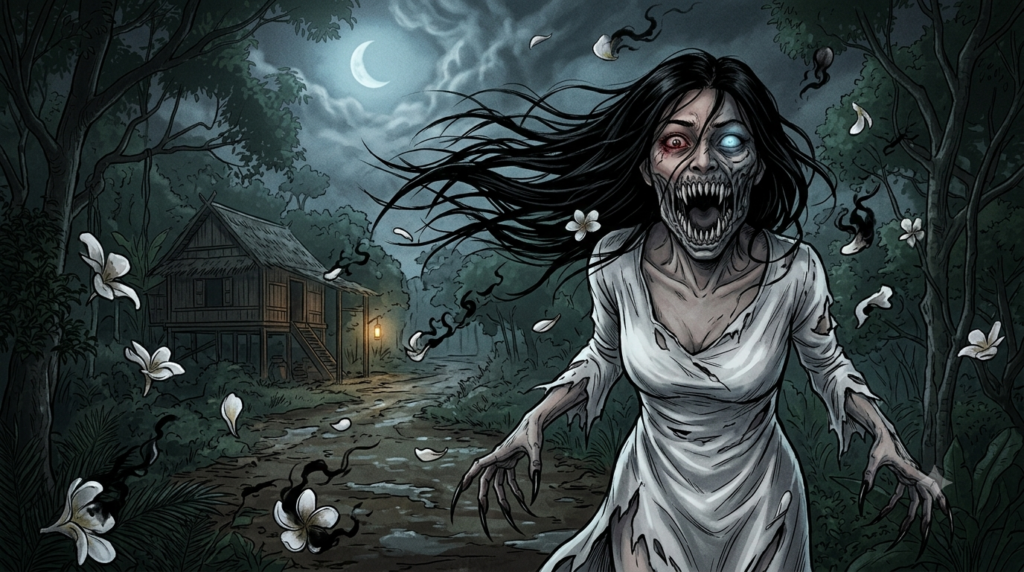
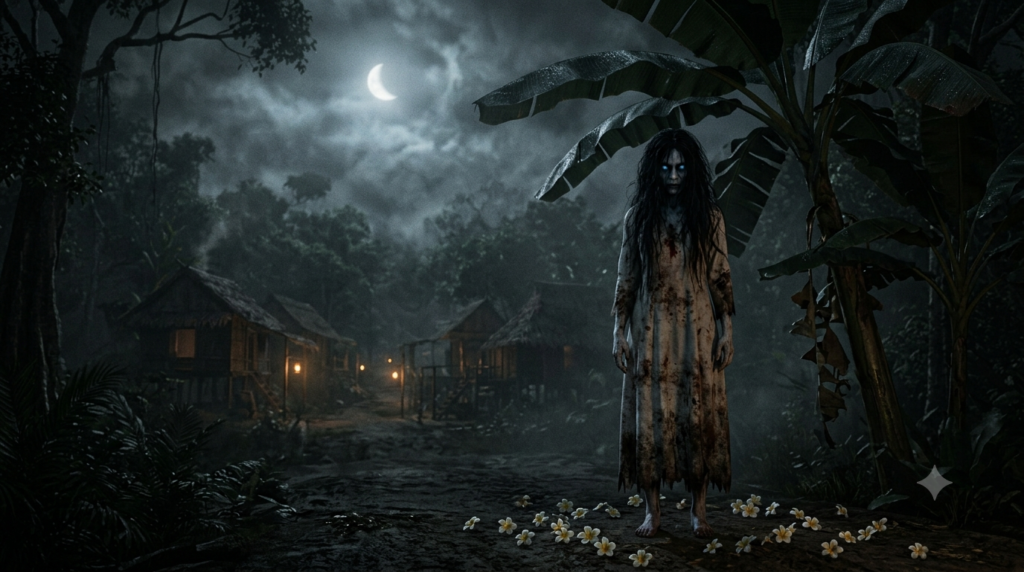
A man walking alone at night may see a woman standing by the roadside. She may have long black hair, pale skin, and a white dress. She may cry softly. She may ask for help. She may appear vulnerable, lost, or wounded.
But when he comes closer, the illusion breaks.
Her face may become monstrous. Her nails may lengthen. Her eyes may turn cruel. Her beautiful form may reveal the rage of something no longer human.
What Does a Pontianak Look Like?
The Pontianak is usually described as:
- A pale woman with long black hair
- Wearing a white dress or burial-like clothing
- Beautiful at first glance
- Often appearing near banana trees, quiet roads, forests, or abandoned places
- Associated with a strong floral scent, especially frangipani, followed by decay
- Sometimes heard before she is seen through laughter, crying, or screams
One of the creepiest beliefs about the Pontianak is connected to sound.
In some stories, if her cry sounds far away, she may actually be near. If her voice sounds close, she may be far. This reversal makes the Pontianak feel impossible to locate. She disorients her victim before she attacks.
Penanggalan Vs Pontianak: Key Differences
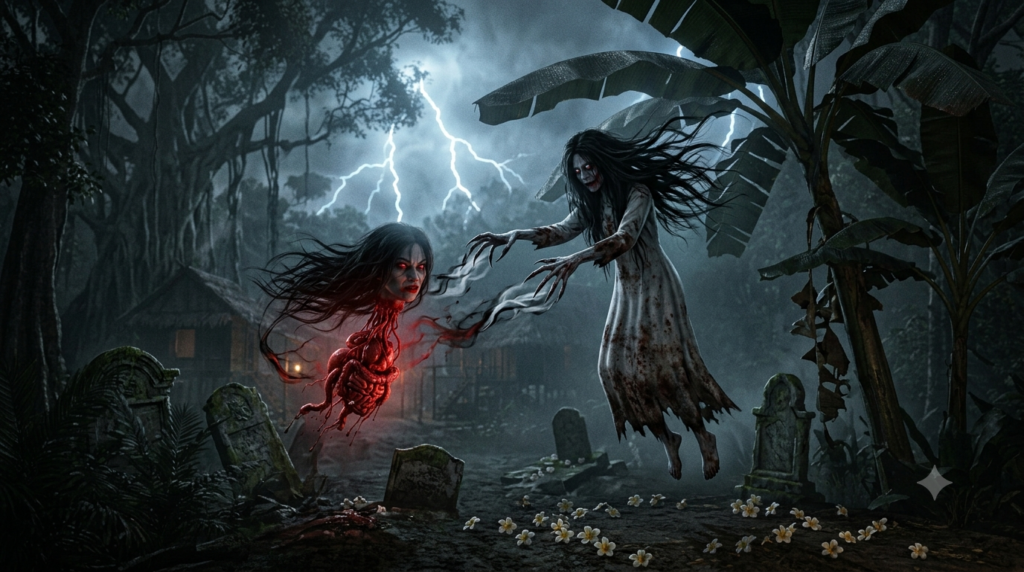
Although people often group them together as female vampire-like beings, the Penanggalan and Pontianak differ in important ways.
| Feature | Penanggalan | Pontianak/ Kuntilanak |
| Main form | Flying female head with internal organs | Female ghost or spirit in white |
| Origin | Often linked to black magic or occult practice | Often linked to tragic death, pregnancy, or childbirth |
| Nature | Usually a living or transformed supernatural being | Usually a restless or vengeful spirit |
| Main fear | Blood, babies, pregnant women, body horror | Seduction, revenge, haunting, sudden attack |
| Appearance | Grotesque and monstrous | Beautiful at first, terrifying later |
| Common regions | Malaysia, Indonesia, Brunei, southern Thailand | Malaysia, Indonesia, Brunei, Singapore |
| Similar beings | Manananggal, Leyak | Kuntilanak, Langsuir, other female ghosts |
The simplest way to remember the difference is this:
The Penanggalan is body horror. The Pontianak is ghost horror.
One terrifies because her body separates and flies.
The other terrifies because grief itself has returned from the grave.
Is Pontianak the Same as Kuntilanak?
In many contexts, Pontianak and Kuntilanak refer to closely related or overlapping female ghost traditions.
The word Pontianak is more commonly used in Malaysia, Singapore, and Brunei, while Kuntilanak is widely used in Indonesia. However, local stories vary. Some communities may treat them as basically the same spirit, while others describe differences in behaviour, origin, or appearance.
Generally, both are associated with:
- A female ghost
- Long hair
- White clothing
- Death during pregnancy or childbirth
- Revenge or haunting
- Attacks on men or vulnerable people
This is why many people search for Kuntilanak vs Pontianak, even though the difference often depends on local tradition rather than one fixed universal rule.
Which is More Dangerous: Penanggalan or Pontianak?
That depends on what kind of horror frightens you more.
The Penanggalan is terrifying because she is physically grotesque. She is a flying head with organs, hunting in the night for blood. Her horror is immediate, visual, and almost impossible to forget.
The Pontianak is terrifying because she is deceptive. She may appear beautiful. She may sound like a crying woman. She may lure people through sympathy, desire, or curiosity. Her horror depends on the moment when the victim realises the woman in front of him is not human.
If the Penanggalan is a nightmare seen through a window, the Pontianak is the stranger you stopped to help by the roadside.
Both are dangerous.
But the Pontianak may be more psychologically frightening because she begins as something familiar.
Why Are These Spirits Usually Female?
This is one of the most interesting questions in Southeast Asian folklore.
The Penanggalan and Pontianak are not random monsters. They reflect deep cultural fears surrounding childbirth, death, blood, female power, sexuality, beauty, social boundaries, and the dangers of the night.
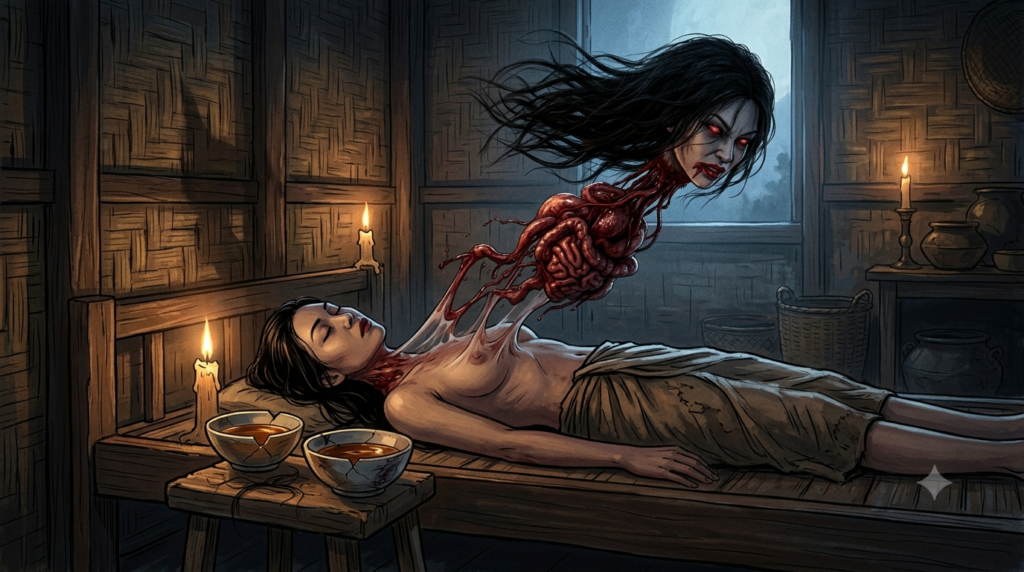
In traditional village life, childbirth was dangerous. Many women died during pregnancy or delivery. Infants were vulnerable. Illnesses could spread quickly. Sudden death often demanded explanation, and folklore gave shape to fears that people could not easily control.
A ghost like the Pontianak may represent grief, injustice, and the fear of a woman who died before her time. A creature like the Penanggalan may represent anxiety about hidden evil, forbidden knowledge, or someone living among the community while secretly bringing harm.
These stories also warn people not to wander alone, not to trust appearances, and not to ignore the unseen world.
In that sense, these legends are not only horror stories.They are cultural warnings.
Similar Female Spirits in Southeast Asia
The Penanggalan and Pontianak are part of a much wider supernatural family.
Across Southeast Asia, many cultures tell stories of female spirits, night hunters, and shape-shifting beings. Some are vengeful. Some are protective. Some are connected to childbirth, forests, rivers, or the dead.
Here are a few related beings:
Manananggal – Philippines
The Manananggal is a vampire-like creature whose upper body separates from the lower half and flies at night. Like the Penanggalan, it is strongly associated with body separation and nocturnal hunting.
Aswang – Philippines
The Aswang is a broad category of Filipino supernatural beings that may include ghouls, witches, shapeshifters, and blood-drinkers. It is among the most feared creatures in Philippine folklore. Read Aswang: Terrifying Nightmares & 3 Spine-Chilling Scary Stories That Will Haunt You
Langsuir – Malaysia
The Langsuir is another female spirit in Malay folklore, often linked to death during childbirth. She is sometimes closely related to the Pontianak tradition.
Leyak – Bali, Indonesia
The Leyak is a frightening being in Balinese folklore, often described as a flying head with organs, making it visually similar to the Penanggalan.
Rangda – Bali, Indonesia
Rangda is the terrifying queen of witches in Balinese mythology, often associated with black magic, death, and the cosmic battle against Barong. Rangda is frequently listed among Southeast Asia’s major mythic or demonic figures.
These beings show how rich and interconnected Southeast Asian supernatural traditions are. Each culture has its own details, but many share common fears: the night, the forest, death, blood, betrayal, and the dangerous boundary between human and spirit.
Why the Penanggalan and Pontianak Still Scare People Today
Modern people may no longer live in villages surrounded by jungle. They may sleep in apartments, drive on highways, and scroll through ghost stories on their phones.
But the fear remains.
Why?
Because the Penanggalan and Pontianak touch something older than logic.
The Penanggalan frightens us because the human body becomes wrong. It breaks the rules. A head should not fly. Organs should not trail through the sky. A neighbour should not become a monster after sunset.
The Pontianak frightens us because she hides horror behind beauty. She reminds us that danger may appear helpless, attractive, or familiar. Her story begins with sympathy and ends with terror.
Both legends survive because they are not only about monsters.
They are about suspicion.
They are about grief.
They are about women wronged by death, power, or society.
They are about what waits outside the safety of light.
And perhaps that is why these stories continue to be told.
Because somewhere in Southeast Asia, on a quiet road lined with banana trees, someone still hears a woman laughing in the dark.
And no one wants to turn around first.
Frequently Asked Questions About Penanggalan vs Pontianak
What is the main difference between Penanggalan and Pontianak?
The main difference is that the Penanggalan is usually described as a flying female head with internal organs hanging below it, while the Pontianak is usually a female ghost or spirit, often linked to death during pregnancy or childbirth.
Is Pontianak the same as Kuntilanak?
Pontianak and Kuntilanak are closely related. Pontianak is more commonly used in Malaysia, Singapore, and Brunei, while Kuntilanak is widely used in Indonesia. In many stories, they refer to a similar female ghost.
Is the Penanggalan a vampire?
The Penanggalan is often described as a vampire-like creature because she feeds on blood and hunts at night. However, she is different from Western vampires because her head detaches from her body and flies with her organs exposed.
Why does the Pontianak wear white?
The Pontianak is often described as wearing white because white is associated with death, burial, mourning, or ghostly appearance in many regional stories. Her white dress also creates a strong visual contrast with her long black hair.
Are Penanggalan and Pontianak real?
They are part of Southeast Asian folklore and supernatural belief. Whether people believe they are real depends on personal, cultural, and spiritual views. In many communities, stories about these beings are still told seriously.
Which countries have Penanggalan and Pontianak stories?
Stories of the Penanggalan and Pontianak appear mainly in Malaysia, Indonesia, Brunei, Singapore, and related Malay-speaking cultural regions. Similar beings also exist in neighbouring Southeast Asian folklore traditions.
What creature is similar to the Penanggalan?
The Manananggal of the Philippines and the Leyak of Bali are often compared to the Penanggalan because they involve body separation, flying at night, and supernatural feeding.
Final Thoughts
The Penanggalan and Pontianak are two of Southeast Asia’s most terrifying female supernatural beings, but they frighten in very different ways.
The Penanggalan is a grotesque flying horror, a severed head with organs trailing beneath her as she hunts through the night.
The Pontianak is a ghost of sorrow and vengeance, beautiful from afar but deadly when approached.
One is remembered for her body.
The other is remembered for her cry.
Together, they show why Southeast Asian folklore is among the richest and darkest in the world. These are not simple ghost stories. They are warnings carried through generations, whispered from village paths to modern cities, from old kampung houses to horror films and internet legends.
So if you ever smell flowers on an empty road, or hear laughter where no one should be standing, keep walking.
And whatever you do, do not look back.
Follow us on Youtube!
Leave a Reply