
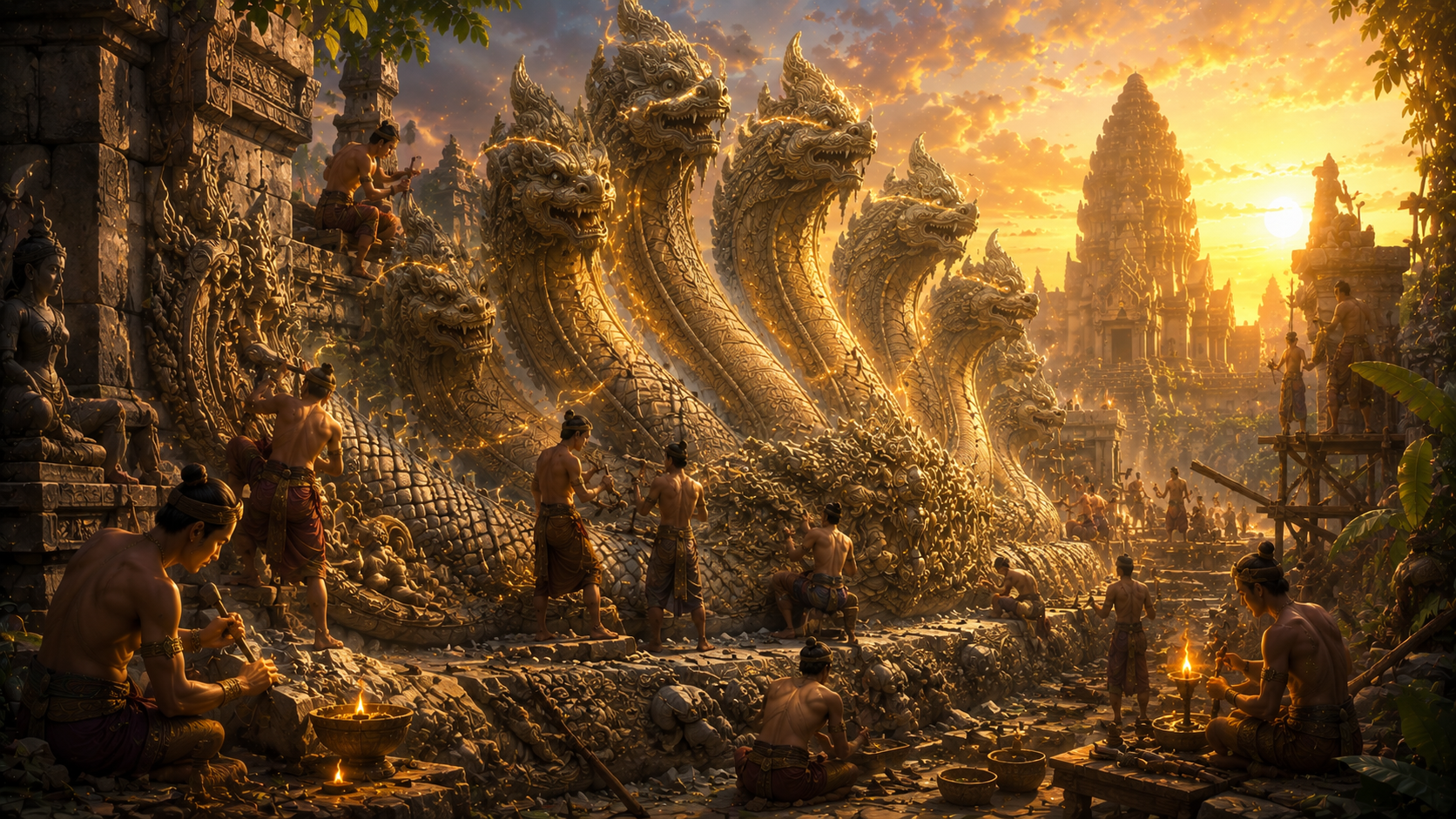
Naga legends are among the most powerful and mysterious stories in Southeast Asian folklore. Across temples, rivers, royal symbols, Buddhist art, Hindu cosmology, and village beliefs, the naga appears again and again as a sacred serpent connected to water, protection, fertility, ancestry, and divine power. In mythology, the naga is not just a snake. It is a guardian, a creator, a bridge between worlds, and in Cambodia, a symbol tied deeply to the origin of the Khmer people.
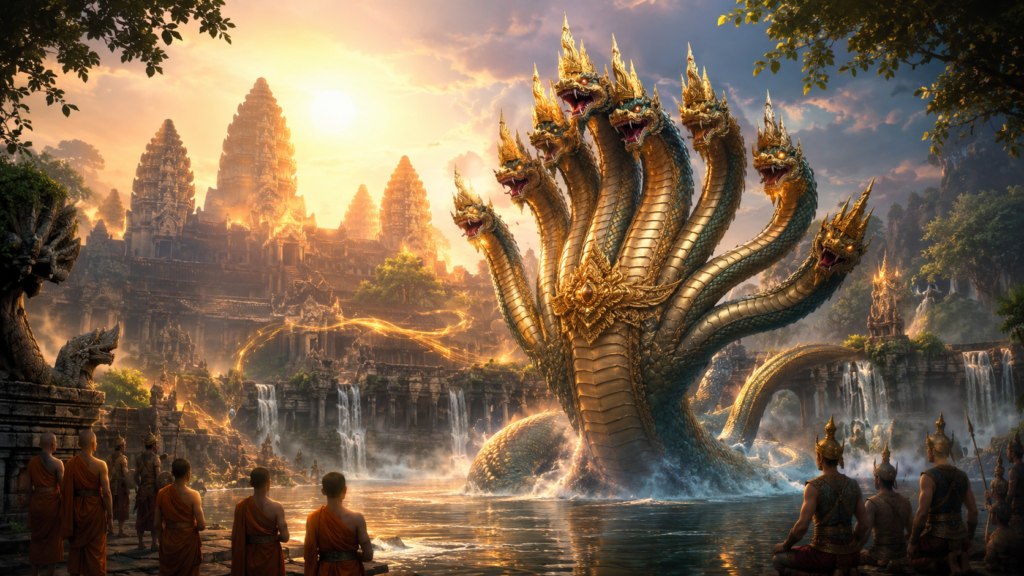
For anyone interested in Southeast Asian legends, the naga is one of the most important mythical beings to understand. The Cambodia naga tradition is especially rich because it appears in royal origin myths, temple architecture, Angkorian sculpture, Buddhist images, and everyday cultural identity. From the grand causeways of Angkor Wat and Angkor Thom to stories of the naga princess who helped give birth to Cambodia, it remains a living symbol rather than a forgotten myth.
The word naga comes from Sanskrit and generally refers to a serpent or serpent being. In Hindu and Buddhist traditions, nagas are usually described as semi-divine beings associated with water, underground realms, wisdom, treasure, fertility, and protection.
But in Cambodia, the naga becomes even more than a religious figure. The Cambodia naga is an ancestral being. It is part of the founding imagination of the Khmer world. It appears as the serpent who guards sacred spaces, the mystical force beneath the waters, and the divine ancestor connected to the birth of the Cambodian people. This is why the naga is so important not only in mythology, but also in Cambodian identity.
Why the Naga Is So Powerful in Mythology
The naga is powerful because it represents several ideas at once. In mythology, it is associated with water, fertility, protection, hidden wisdom, danger, and transformation. This makes it more complex than a simple monster or serpent. The naga can protect temples, bless the land, guard treasures, shelter holy figures, and punish those who disrespect sacred boundaries.
Many cultures fear snakes because they are dangerous and unpredictable. At the same time, snakes are also symbols of renewal because they shed their skin. The naga takes this natural symbolism and transforms it into something sacred. In Hindu and Buddhist traditions, the naga often lives in watery or underground realms, linking it to rivers, lakes, rain, fertility, and the unseen forces beneath the earth.

This water connection is especially important in Southeast Asia. Civilisations in Cambodia, Thailand, Laos, Myanmar, and other regions depended heavily on rivers, monsoons, rice fields, and flood cycles. A being like the naga naturally became a symbol of life-giving water. But water can also destroy through floods, storms, and drowning. That is why the naga has a dual nature. The naga can give life, but the naga can also take it away.
This dual nature gives naga mythology emotional depth. The naga is not purely good or evil. Instead, the naga represents sacred power. Like water itself, the naga must be respected
The Naga in Hindu and Buddhist Mythology
To understand the Cambodia naga, it is helpful to first understand the wider religious background of the naga in Hindu and Buddhist traditions. In Hindu mythology, nagas are often linked to cosmic stories, divine beings, and sacred waters. Some famous nagas include Shesha or Ananta, the cosmic serpent associated with Vishnu, and Vasuki, the serpent used in the famous churning of the ocean myth.
In Buddhism, the naga often becomes a protector of sacred teaching. One of the most famous Buddhist images shows the Buddha seated in meditation while a multi-headed naga spreads its hood over him as protection from rain and storm. This image is common across Southeast Asia, including Cambodia. In this form, the naga becomes a guardian of wisdom and enlightenment.
This is one reason the naga appears so often at temple entrances. The naga stands at the boundary between the ordinary world and the sacred world. When a visitor enters a temple past a naga balustrade, they symbolically pass from human space into divine space. This is very important in Khmer temple architecture, where naga forms often line causeways, staircases, terraces, and gateways.
The Cambodia Naga: Sacred Serpent of Khmer Origins
The Cambodia naga is especially compelling because it is tied to one of Cambodia’s most important origin legends. In Khmer tradition, a foreign prince named Kaundinya, also associated in local versions with Preah Thong, arrives in the land and meets a naga princess, often called Soma or Neang Neak. After their union, the naga king, father of the princess, drinks away the waters to reveal land for their descendants. This myth explains the origin of Cambodia and the Khmer people.
This story appears in several cultural retellings and is closely connected to Cambodia’s sense of sacred ancestry. Sources on Khmer naga traditions describe the naga princess Soma and Kaundinya legend as a foundational myth in which the naga king creates land for their descendants.

This is why the Cambodia naga is not just a temple decoration. The naga is part of a national origin story. The naga is imagined as an ancestor, a creator, and a source of legitimacy. Through the naga princess, the Khmer people are symbolically linked to the sacred serpent world.
This makes the naga different from many other mythical creatures. Dragons in some traditions are enemies to be defeated. Monsters are often threats to be destroyed. But the Cambodian naga is an ancestor to be honoured. The naga is part of the family line of the land itself.
Naga at Angkor: The Stone Serpent of Cambodia
No discussion of the naga would be complete without Angkor. Angkor is one of the most important archaeological sites in Southeast Asia. UNESCO describes Angkor Archaeological Park as covering around 400 square kilometres and containing remains of Khmer Empire capitals from the 9th to the 15th centuries, including Angkor Wat and Angkor Thom [whc.unesco.org]
At Angkor, the naga appears everywhere: along causeways, bridges, temple entrances, balustrades, lintels, and sacred terraces. The long stone bodies of the naga often stretch along pathways, while multi-headed naga hoods rise dramatically at the ends. These naga forms are not accidental decorations. They carry religious and symbolic meaning.
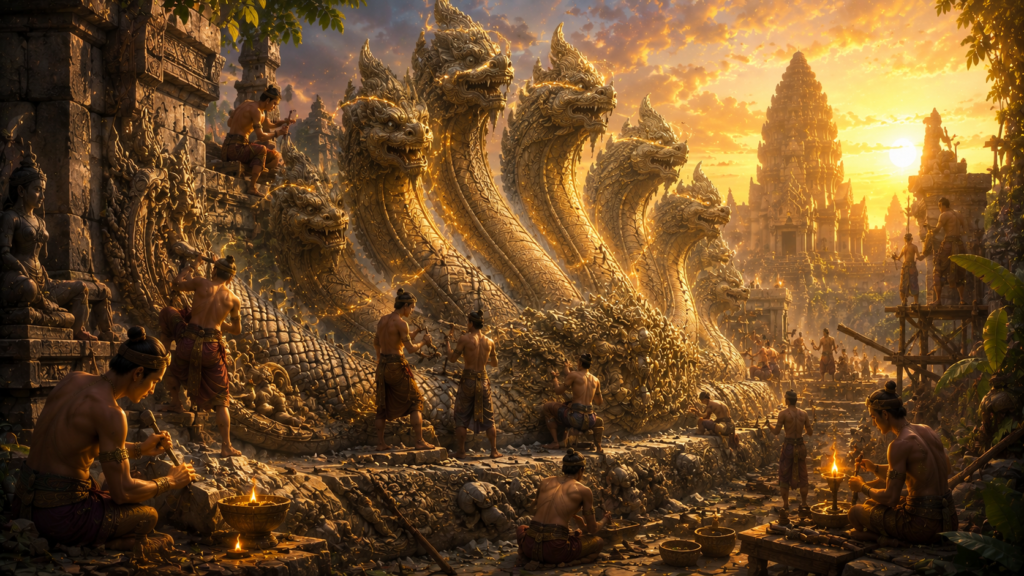
The Cambodia naga at Angkor often marks sacred passage. A visitor walking across a naga-lined causeway is not simply walking into a building. Symbolically, they are crossing from the human world into the cosmic world of the temple. Many Khmer temples were designed as symbolic representations of Mount Meru, the sacred mountain in Hindu and Buddhist cosmology.
Naga Mythology and the Sacred Geography of Cambodia
The naga is strongly connected to landscape. Unlike some myths that exist only in stories, naga mythology is visible in real places. In Cambodia, the naga appears in ancient temple complexes, royal architecture, river traditions, Buddhist sanctuaries, and modern public spaces.
Angkor is the most famous example, but the Cambodia naga is not limited to Angkor Wat. Sources discussing naga sites in Cambodia mention Angkor Thom, Preah Khan, the Royal Palace in Phnom Penh, Tonle Sap waterways, and Phnom Kulen as places where naga imagery or water-related symbolism remains important.
The sacred geography of the naga also shows how mythology and environment connect. Cambodia’s civilisation developed around water management, rice agriculture, reservoirs, and river systems. The naga, as a water serpent, reflects this dependence on water. In this sense, the naga is not only a religious symbol, it is also an ecological symbol.
The naga reminds people that water is sacred, powerful, and necessary for survival.

Frequently Asked Questions About the Naga
What is a naga?
A naga is a sacred serpent or serpent-like being found in Hindu, Buddhist, and Southeast Asian traditions. The naga is often associated with water, fertility, protection, hidden wisdom, and divine power.
What is naga mythology?
Naga mythology refers to the body of myths, legends, religious stories, and cultural beliefs about nagas. These stories appear in Hinduism, Buddhism, and many Southeast Asian cultures. In naga mythology, the naga may be a guardian, ancestor, water spirit, treasure keeper, or cosmic serpent.
What is the Cambodia naga legend?
The Cambodia naga legend often refers to the story of a human prince, commonly associated with Kaundinya or Preah Thong, who marries a naga princess named Soma or Neang Neak. Her father, the naga king, creates land for their descendants, symbolically explaining the origin of Cambodia and the Khmer people.
Why is the naga important at Angkor Wat?
The naga is important at Angkor Wat and other Khmer temples because it represents protection, sacred passage, water, and cosmic power. Naga balustrades and sculptures mark temple entrances and causeways, guiding visitors from ordinary space into sacred space.
Is the naga good or evil?
The naga is not simply good or evil. It can be protective, wise, generous, and sacred, but it can also be dangerous when disrespected. The naga represents powerful natural and spiritual forces.

The Naga Is Cambodia’s Sacred Serpent of Memory, Mystery, and Power
The naga is one of the most compelling mythical beings in Asia. In Cambodia, the Cambodia naga becomes even more powerful because it is tied to the origin of the Khmer people, the sacred architecture of Angkor, and the living identity of the nation.
From the naga princess of Cambodia’s founding legend to the multi-headed naga sculptures guarding Angkor’s causeways, the naga continues to shape how people understand land, ancestry, spirituality, and protection. The naga is not merely a creature of the past. It still lives in stone, story, ritual, art, and memory.
To understand the naga is to understand one of Southeast Asia’s deepest symbols. It is the serpent beneath the waters, the guardian at the temple gate, the ancestor of a people, and the sacred bridge between the human world and the divine.
If you liked this article, read The Remarkable Timor-Leste Crocodile Legend: How an Island Was Born From a Sacred Beast
Leave a Reply