
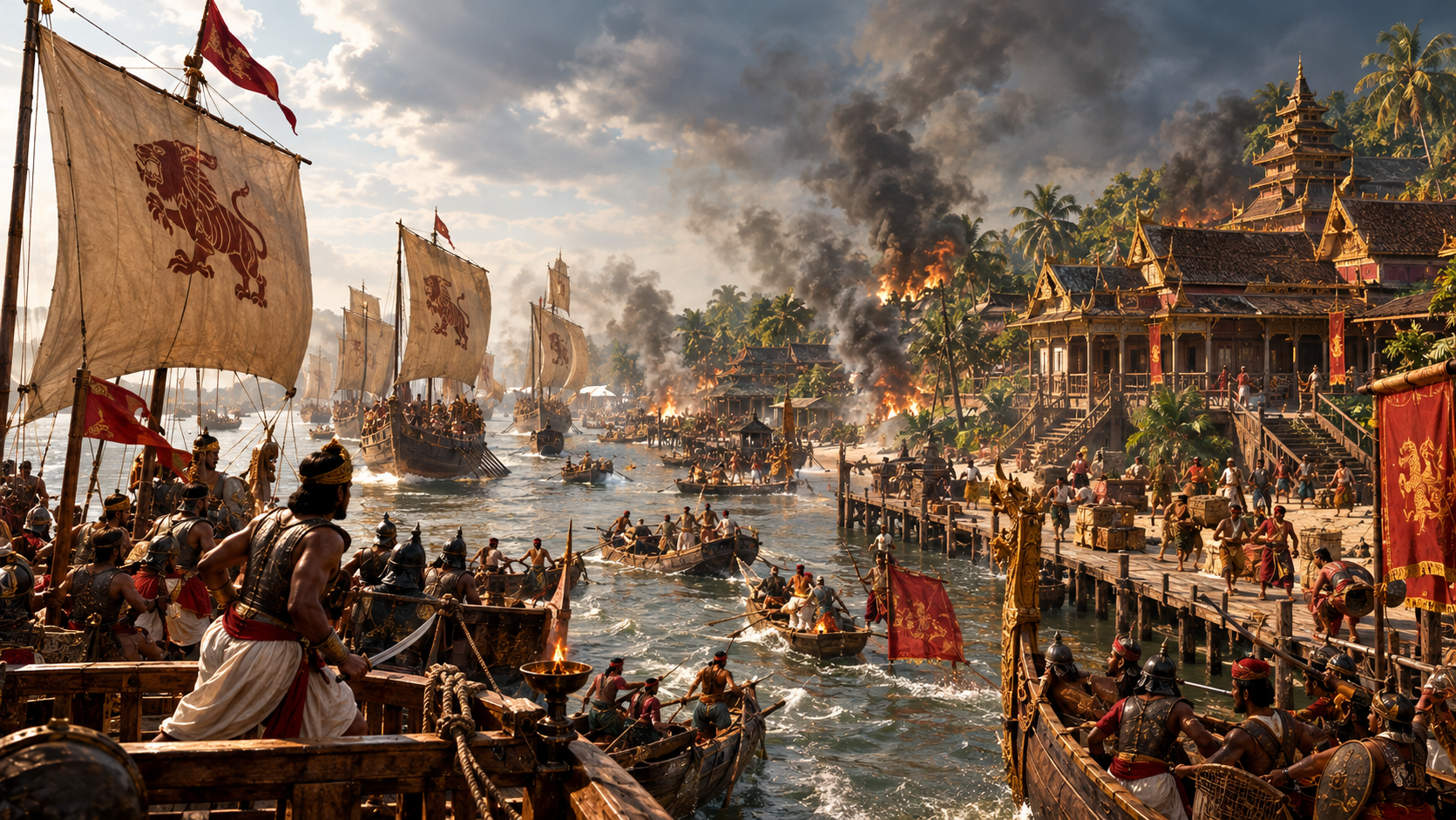
The Srivijaya Empire was one of the great maritime powers of Southeast Asia, but for many centuries most of its history had almost vanished. Based in the area of Palembang in Sumatra, it prospered from about the seventh to the thirteenth century and held control of important maritime trade routes while at the same time forming links with both China and India.
For readers from Malaysia and those interested in Malay history, the Encyclopaedia Britannica refers to the Srivijaya Empire as “the Malay kingdom of Srivijaya-Palembang” and the inscriptions of Srivijaya from the seventh century were composed in Old Malay.
The following are 15 facts and mysteries relating to this remarkable civilization.
1. Srivijaya Was a Malay Maritime Power
The idea of a Malay connection is not merely a modern nationalist interpretation; the inscriptions left by Srivijaya themselves from the seventh century are in Old Malay and are written in a script derived from Indian script.
Srivijaya’s political centre was in Sumatra, in present-day Indonesia, and it would therefore be misleading to say that it belonged to a modern nation; historically, though, it represented an important early phase in the broader Malay world.
2. One Stone Preserves an Ancient Malay Voice
The well-known Kedukan Bukit inscription, which was found near Palembang, dates from 683 CE and is written in Old Malay with the use of the Pallava script; it is regarded as the oldest example of the Malay language that has survived to the present day.
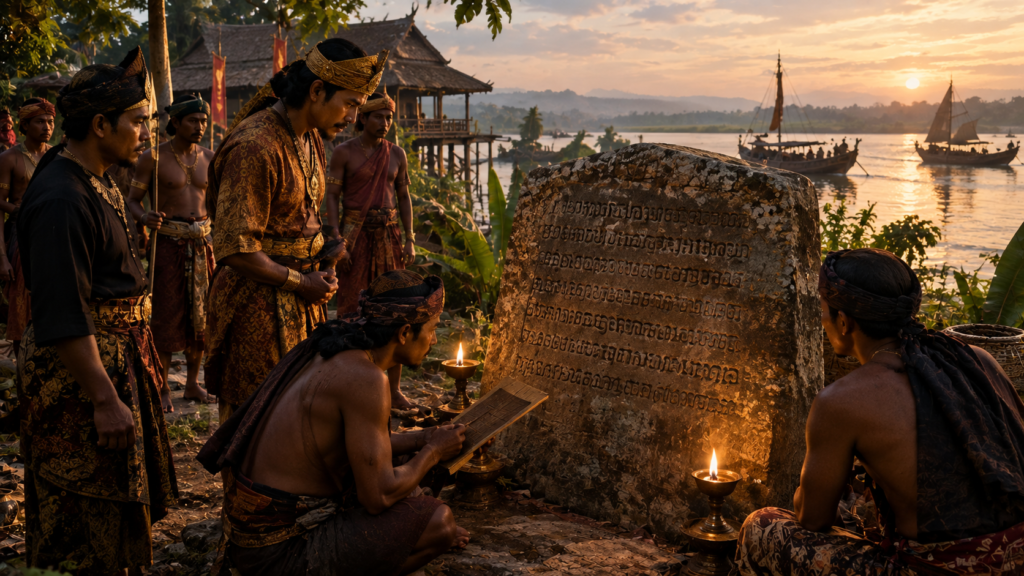
To imagine hearing those words spoken over 1,300 years ago, one would find them unfamiliar to present-day Malay speakers, even though they are part of the linguistic ancestry of the language.
3. Its Founder Went on a Mysterious “Sacred Journey”
The inscription speaks of a king named Dapunta Hyang who carried out a siddhayatra, a practice generally understood to be a journey or expedition associated with supernatural or spiritual achievement, and it mentions the presence of thousands of followers as well as the founding of a vanua, that is, a settlement.
It was a military invasion, a royal foundation ceremony, a sacred expedition, or all of them? Interpretation is still part of the mystery of the Srivijaya Empire.
4. Palembang Was Its Heartland
For many years scholars argued about the true location of Srivijaya’s centre. Archaeological findings to the west of present-day Palembang have brought to light a large number of ceramics and religious relics, which support the evidence from texts that identify the Palembang area as the heartland of the Srivijaya Empire.
5. Its Power Came From the Sea
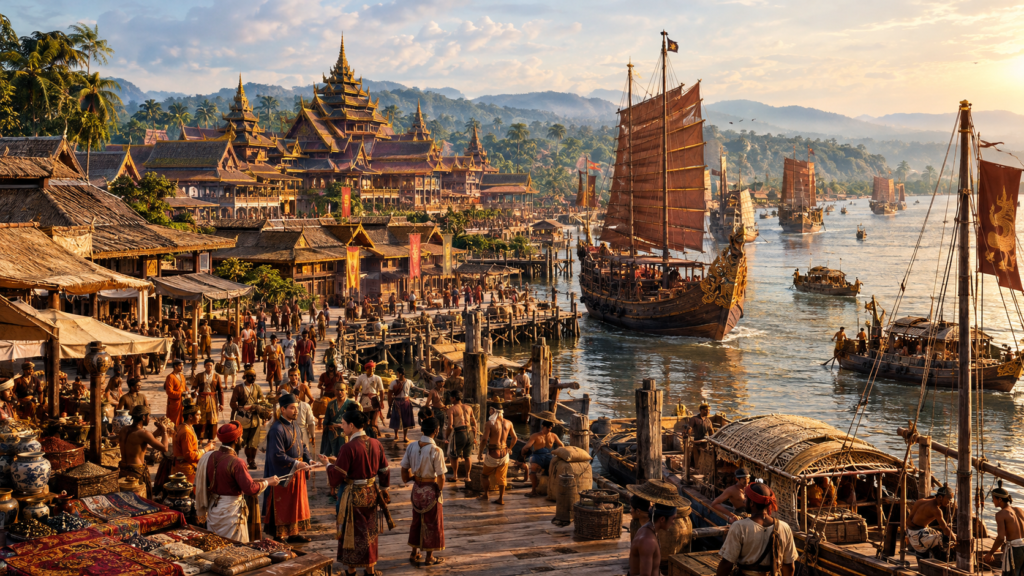
The Srivijaya Empire attained its power as a result of international maritime trade; because of its strategic location it was able to exert influence over the Strait of Malacca and the trade routes which connected the Malay Archipelago with India and China.
Its strength was therefore unlike that of a conventional land empire; waterways formed its highways.
6. Ancient Kedah Was Closely Connected to Srivijaya
The importance of the Malaysian connection is especially noticeable here.
The study published in Jurnal Arkeologi Malaysia in 2022 concludes that Ancient Kedah was closely integrated into the Srivijaya empire mandala while at the same time retaining autonomous authority over its own polity, and that this relationship was commercially important because of its strategic port location.
The history of the Srivijaya empire therefore belongs to both sides of the Strait of Malacca.
7. Srivijaya Became an International Buddhist Centre
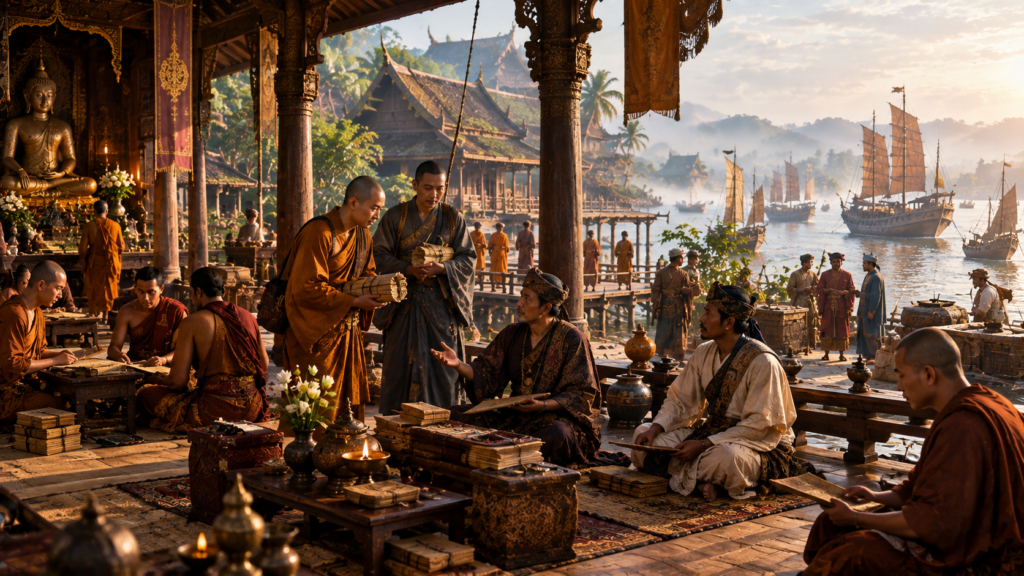
Srivijaya was not only interested in money; it also developed into an important centre of Mahayana Buddhism and served as a stopping place for Chinese Buddhist pilgrims en route to India.
8. A Chinese Monk Visited in 671
The pilgrim from China who was generally known as Yijing arrived in the Srivijaya empire in 671 CE as he was en route to the great Buddhist teaching centre of Nalanda in India, and the ruler of Srivijaya helped him with his journey.
His writing became invaluable since surprisingly little of Srivijaya’s own written history has survived.
9. Srivijaya Connected the Malay World to India
The rulers of the Srivijaya empire maintained close religious ties with India, as the Britannica points out, having even established monasteries at Nagapattinam in southeastern India.
It indicates that there was a seafaring civilization which exchanged not only goods but also religious knowledge throughout the Bay of Bengal.
10. China Was Another Essential Partner
Srivijaya also formed commercial contacts with China and India and with various other societies in the Malay Archipelago.
This position meant that it lay within one of the most important commercial routes of ancient Asia.
11. Its Capital May Not Have Looked Like Angkor
One of the reasons why Srivijaya appeared for so long to be almost completely invisible to archaeologists is the character of the terrain. The archaeological findings in the area of Palembang focus on river-side settlements, imported ceramics, religious sculpture and remains, rather than on a huge number of surviving stone pillars.
One of the greatest mysteries surrounding it is exactly what Srivijaya looked like when it was at its peak.
12. An Indian Navy Struck It in 1025
Then came catastrophe.
In 1025 the Chola kingdom from southern India launched an attack on Srivijaya, seized Palembang, took its king and removed the treasure as attacks were made on other parts of the kingdom.
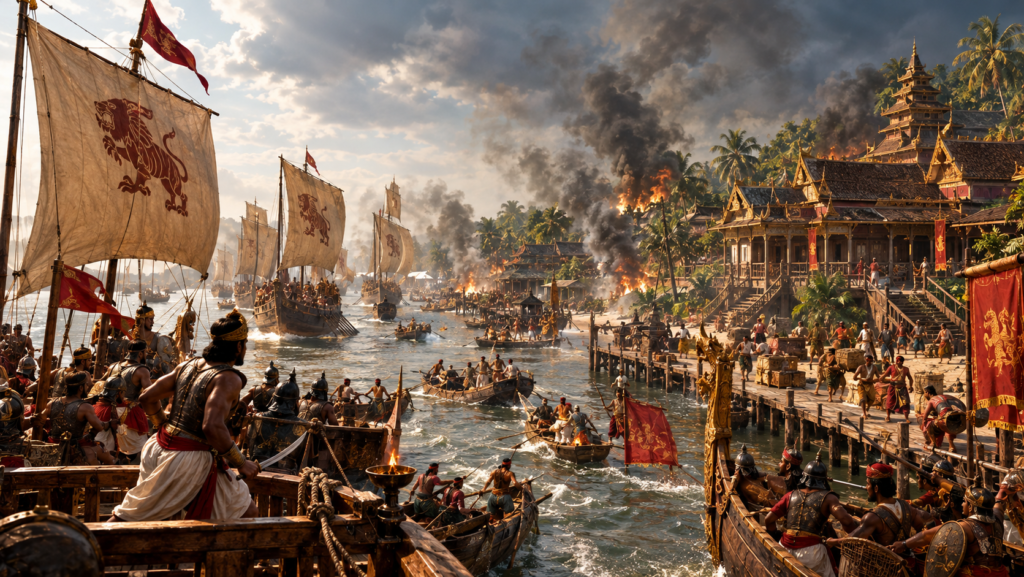
The war is still one of the most dramatic naval engagements in medieval Southeast Asia.
13. Kedah Was Caught in the Conflict
The Chola campaign reached Kedah on the Malay Peninsula, which showed just how important the peninsula was within Srivijaya’s maritime network.
It is a remarkable point of intersection for the study of Malaysian history in that the imperial aspirations of the South Indians came into collision with those of the Malay maritime political network.
14. An Empire Was Almost Forgotten
Maybe the most strange thing about Srivijaya occurred after the kingdom had declined.
Its position as a dominant power declined, and by the end of the twelfth century Britannica states that Srivijaya had been reduced to a small kingdom.
Its historical identity remained a mystery for centuries, and modern scholarship has slowly reconstructed the empire by bringing together inscriptions, Chinese sources, archaeological evidence and records from outside Southeast Asia.
A civilization which was strong enough to link India and China had in effect become a historical riddle.
15. The Greatest Mystery May Be Its Malay Legacy
The Srivijaya Empire ought not to be forced to conform to the current national boundaries in Indonesia and Malaysia; although its centre was on Sumatra, its political, commercial and cultural networks extended across the Malay Archipelago and reached far into the Malay Peninsula.
Most persuasively, the inscriptions offer some of the earliest surviving evidence of Old Malay.
It means that Srivijaya is more than just a vanished Indonesian kingdom or a mere episode in Malaysian history.
It represented one of the great civilizations of the early Malay maritime world.
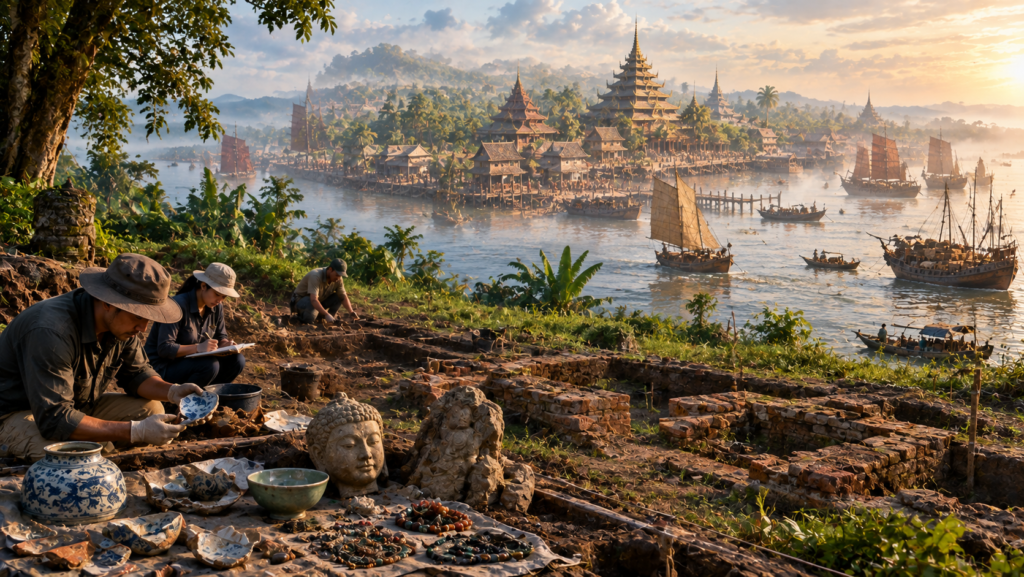
And perhaps that is the greatest Srivijayan mystery of all: an empire that once commanded one of the world’s busiest crossroads left comparatively few monumental traces behind, yet its language, trade networks and cultural connections became part of a wider Malay historical inheritance that survived long after the empire itself disappeared.
If you enjoyed this article, read 7 Hidden Mysteries of Trowulan in Southeast Asia that will blow your mind!
Follow us on YouTube!
Leave a Reply