
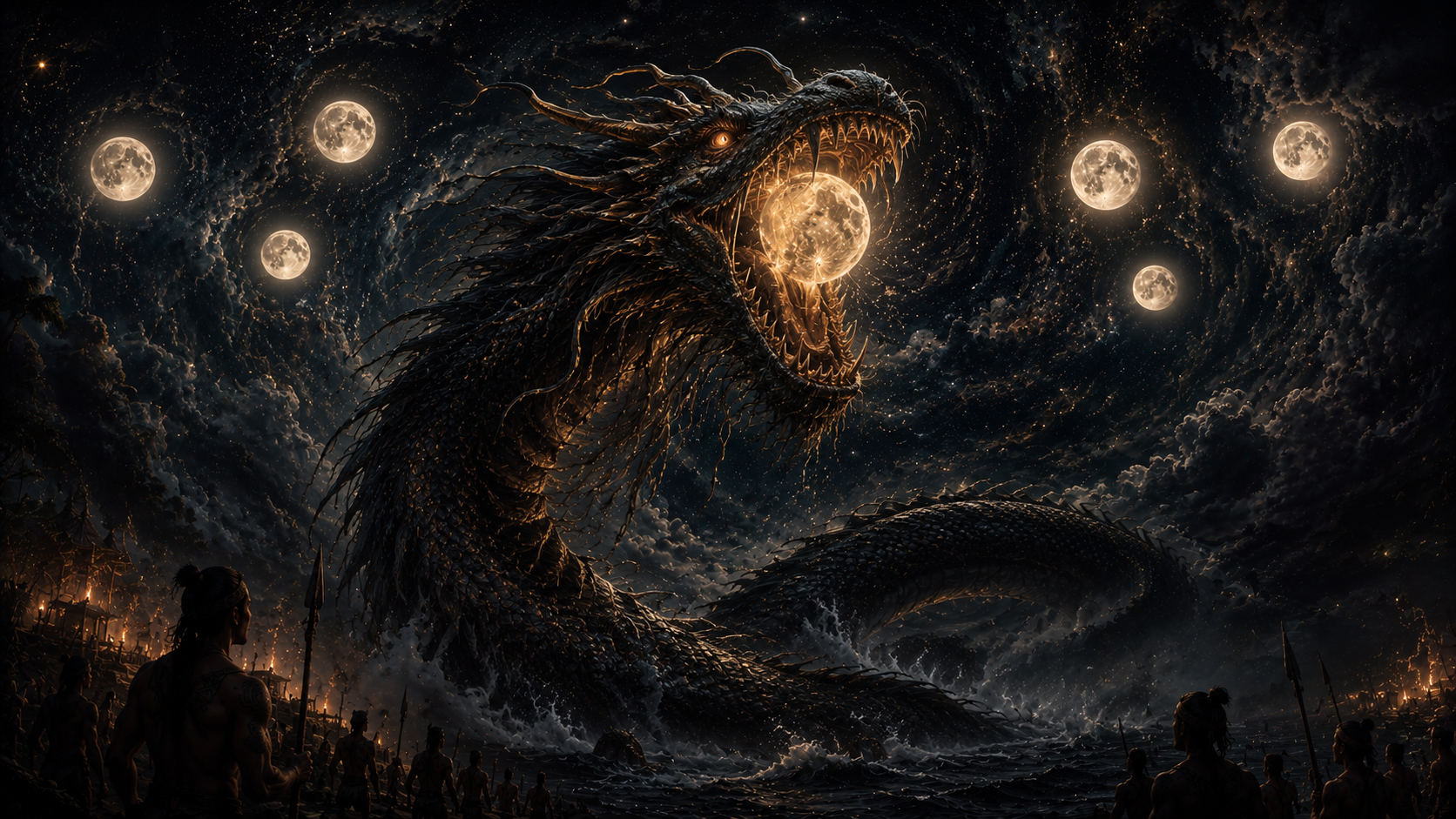
Bakunawa and the seven moons is a well known story in the Philippines.
Long before electricity drowned the night sky, before cities erased the stars with neon light, the people of the ancient Philippines looked upward to the sky with fear, as it was not empty. It was alive.
Somewhere beyond the clouds, beneath the dark cosmic sea, something enormous was waiting.
A creature with scales like black waves, eyes glowing like dying embers and a mouth large enough to swallow the moon itself.
Its name was the Bakunawa.
Most people know the legend in a basic form, a giant serpent dragon that causes eclipses by eating the moon. But the older versions of the story tell something far stranger, and far more terrifying. According to Visayan mythology, there was not just one moon, there were seven.
The story of Bakunawa and the seven moons may actually be one of Southeast Asia’s oldest forgotten apocalypse myths.
The Night the Sky Was Full
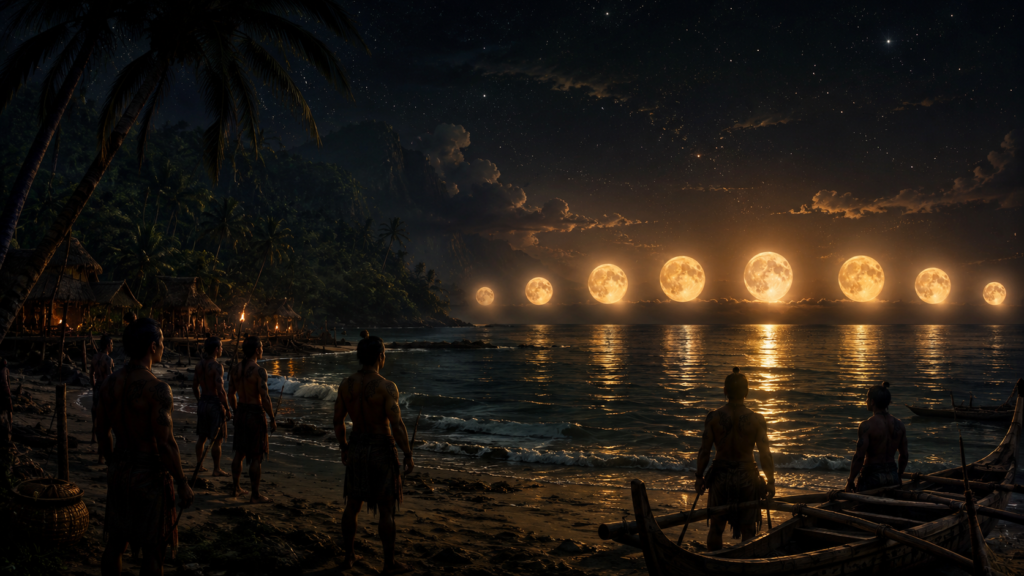
Imagine standing on a beach in the ancient Visayas over a thousand years ago. The sea is calm, the jungle behind you hums with insects.
Then, night falls. But instead of seeing a single moon rise, seven glowing moons slowly appear above the ocean horizon. Some old oral traditions describe them as daughters of the supreme god. Others say they were divine lamps placed in the heavens to illuminate the world equally from every direction. The result was a world without true darkness. Fishermen could sail safely across black waters, villagers could walk through forests after sunset, and crops continued growing beneath the pale glow of the seven moons.
The world was balanced, but too balanced, and that was the problem. Because in many ancient Southeast Asian myths, anything beautiful for too long eventually attracts something hungry.
The Creature Beneath the Cosmic Sea
The Bakunawa is often described today as a dragon, but older depictions make it feel more alien than mythical. Some stories portray it as a gigantic sea serpent coiling around the earth itself. Others describe it as a naga-like creature from the deep abyss, with whiskers, claws, and jaws large enough to consume celestial bodies. But what makes the legend disturbing is not its appearance, it is its obsession.
The Bakunawa did not want to destroy humanity, it only wanted the moons. One by one, the creature rose from the ocean depths and swallowed them. The first moon vanished, then the second, then the third. Ancient people watched pieces of their sky disappear forever, etching the story of Bakunawa and the seven moons forever in their minds.
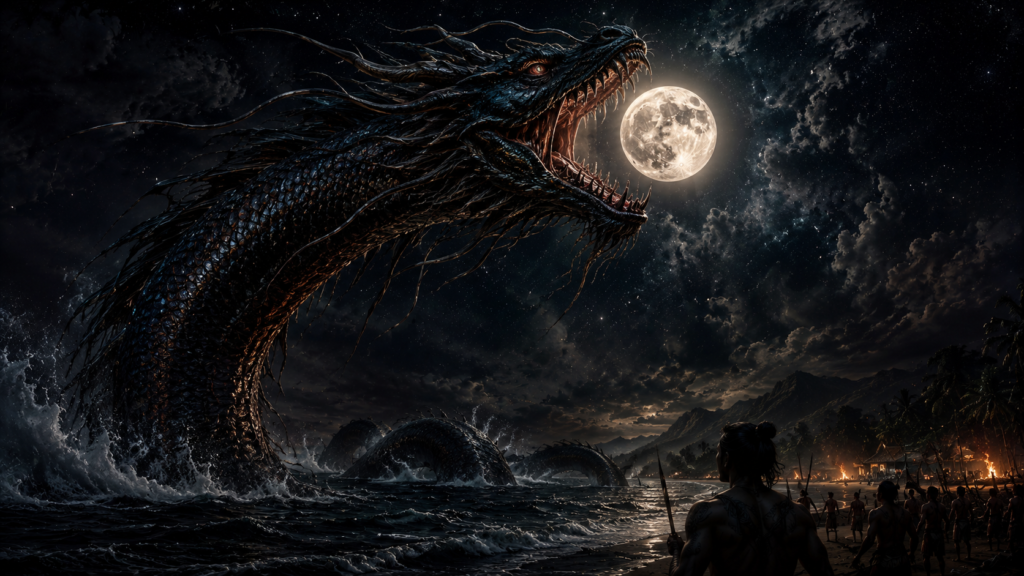
Imagine the psychological horror of that moment. In the modern world, we know what eclipses are, and we understand astronomy. But to ancient communities, the moons were living divine objects, and something was hunting them. This makes the legend of Bakunawa and the seven moons suddenly transform from a simple eclipse story into something closer to cosmic horror, as the sky itself was being eaten alive.
Follow us on TikTok for Southeast Asian related stories!
Why This Story Feels So Different
Most dragon myths involve treasure, kingdoms, or heroes slaying monsters. The Bakunawa myth feels different because humanity is almost powerless in it. There is no great warrior defeating the beast, no magical sword and no triumphant ending. Instead, the people could only fight back with noise.
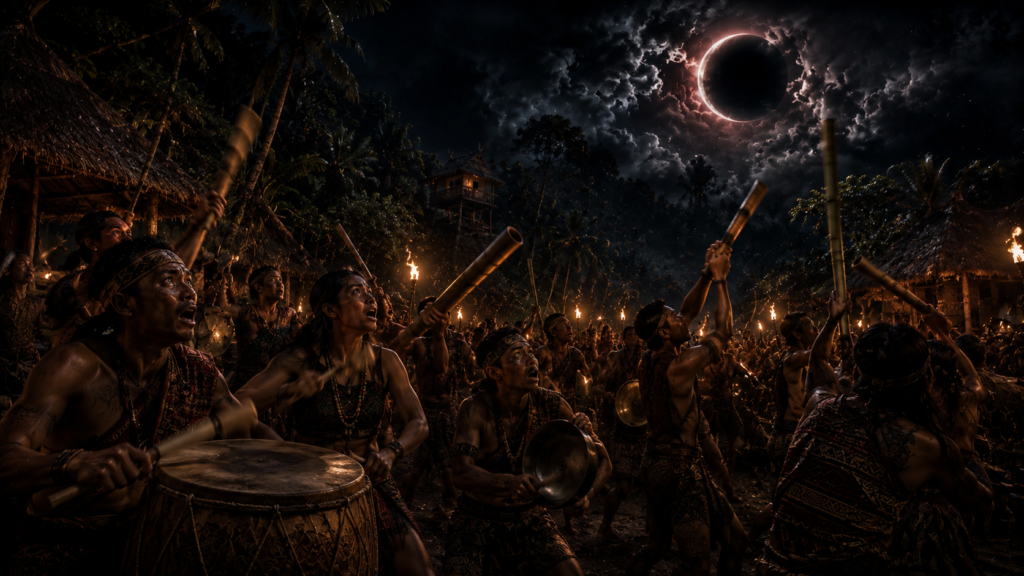
When Bakunawa began swallowing a moon, villagers would rush outside beating drums, clashing pots, screaming into the night, and striking bamboo to frighten the creature into releasing the moon. This practice survived for centuries across parts of the Philippines during lunar eclipses.
If you think about it carefully, it reveals something haunting. The people believed the sky could disappear permanently at any moment. That fear changes the entire tone of the myth, as the Bakunawa was not merely a monster, it was the embodiment of inevitable loss.
The Last Remaining Moon
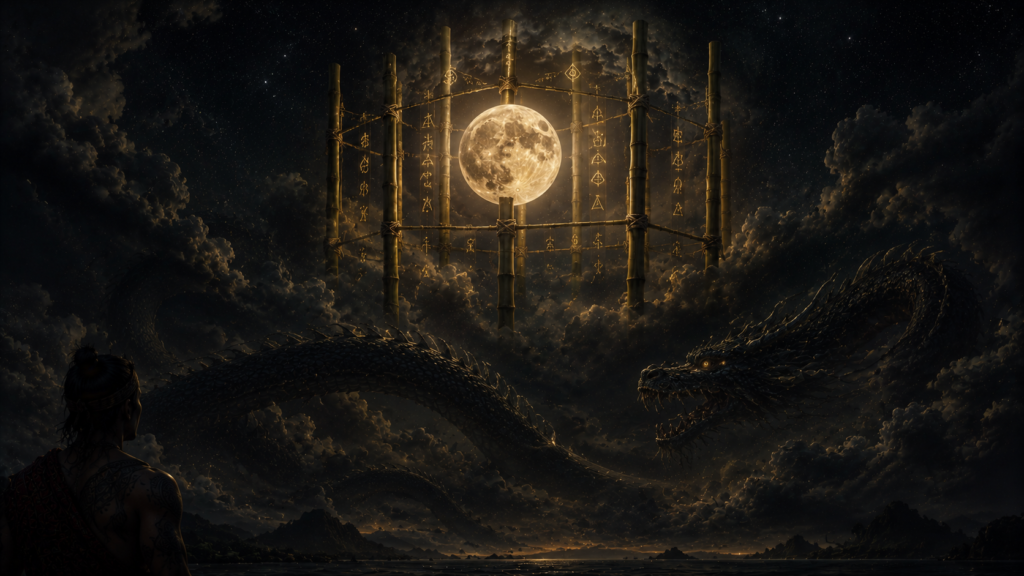
According to some versions of the legend, the Bakunawa successfully devoured six moons and only one survived. The gods, terrified that total darkness would consume the world, protected the final moon with bamboo barriers, and that surviving moon became the one we see today. After knowing this, suddenly the moon overhead no longer feels ordinary. It is the last survivor of a celestial massacre, the final light left untouched by the jaws of an ancient cosmic predator.
That perspective makes every eclipse eerie. For a few moments during an eclipse, the Bakunawa returns.
Could the Myth Hide Something Older?
Here is where the story becomes even more fascinating. Some researchers and folklore enthusiasts believe the legend of Bakunawa and the seven moons may preserve fragments of ancient astronomical observations. They believe the story does not describe seven literal moons orbiting the Earth, but symbolic celestial events instead. Ancient cultures often encoded cosmic disasters into myths. Comets, eclipses, meteor showers, volcanic winters, and unusual planetary alignments became dragons, demons, or angry gods in oral tradition.
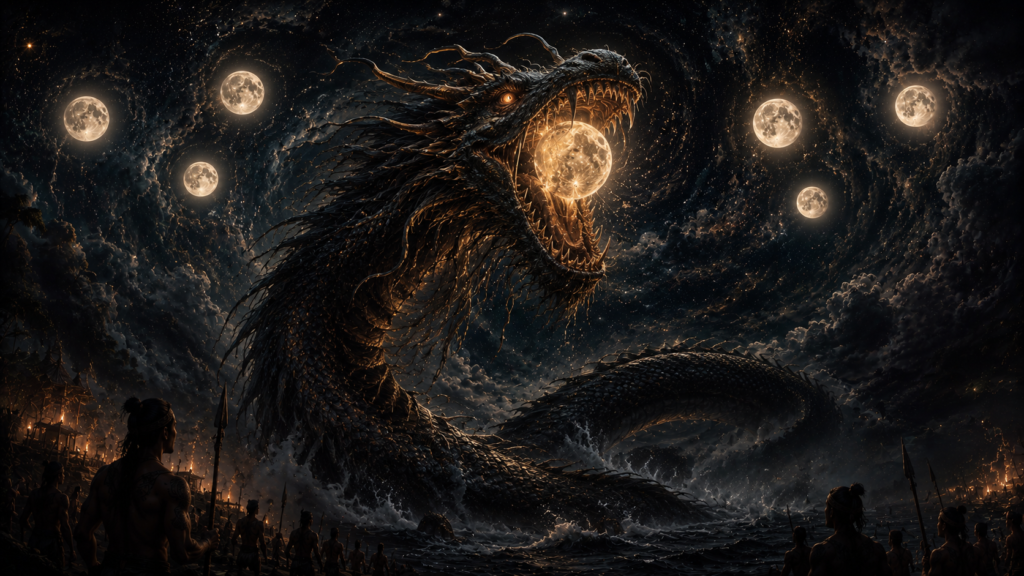
The repeated “eating” of moons may have represented cycles of devastating eclipses that terrified ancient coastal communities. Others believe the seven moons symbolize prosperity itself. Each moon represented abundance, stability, or harmony, and as the Bakunawa consumed them, the world became darker and harsher, mirroring how civilisations slowly decline over generations. Honestly, that interpretation feels deeply human and very relatable.
It stops being only about astronomy, it is about watching beauty disappear one piece at a time.
The Forgotten Connection to Southeast Asian Dragon Lore
The Bakunawa also connects the Philippines to a much larger web of Southeast Asian serpent mythology. Across the region, giant naga beings appear everywhere. For example in Cambodia and Thailand, naga guard temples and rivers. In Indonesia, serpentine dragons appear in old Javanese myths. In Malaysia, stories of giant sea serpents haunted fishermen for generations.
However, the Bakunawa stands apart because it does not guard the world, it consumes it. That distinction makes it one of the darkest mythical creatures in Southeast Asian folklore. It is not a protector, but a devourer of light.
Why the Legend Still Matters Today
Modern people often dismiss myths as entertainment, but stories survive for centuries because they reflect emotional truths humans never outgrow. The story of Bakunawa and the seven moons is no different, it still resonates today because deep down, people still fear the same thing ancient villagers feared, watching the light slowly disappear while being unable to stop it.
Entire cultures have risen and fallen beneath the same moon. Empires vanished, languages disappeared, kingdoms became ruins swallowed by jungle. But through all of it, the final moon remained in the sky, carrying a memory of the six that were lost. Perhaps that is why the Bakunawa myth feels strangely emotional even now, as it reminds us that darkness does not always arrive instantly. Sometimes it comes slowly, one moon at a time.
Somewhere in the ancient imagination of the Philippines, the great serpent is still waiting beneath the cosmic sea, staring upward at the last remaining light in the sky.
If you liked this story of Bakunawa and the seven moons, read Tikbalang: The Twisted Forest Guardian and Trickster of the Philippine Jungles
Leave a Reply