
Exploring the Legends, Origins, and Folklore of the Tikbalang in Philippine Mythology

Have you ever imagined trekking through a jungle, only to realise hours later that you’ve been circling the same spot?
In the Philippines, this is said to happen when a Tikbalang is playing tricks on you.
According to folklore, there is a simple way to break its spell: turn your T-shirt inside out. Doing so is believed to confuse the Tikbalang, causing it to leave you alone.
For generations, stories of the Tikbalang in the Philippines have been passed down through oral tradition, whispered by elders and shared among travellers venturing into the wilderness. These tales were not just meant to frighten, but to explain the dangers of the natural worlds, and to remind people that nature was never fully under human control.
Revered and feared in equal measure, the Tikbalang is one of the most famous mythical creatures of the Philippines.
The Appearance of the Tikbalang
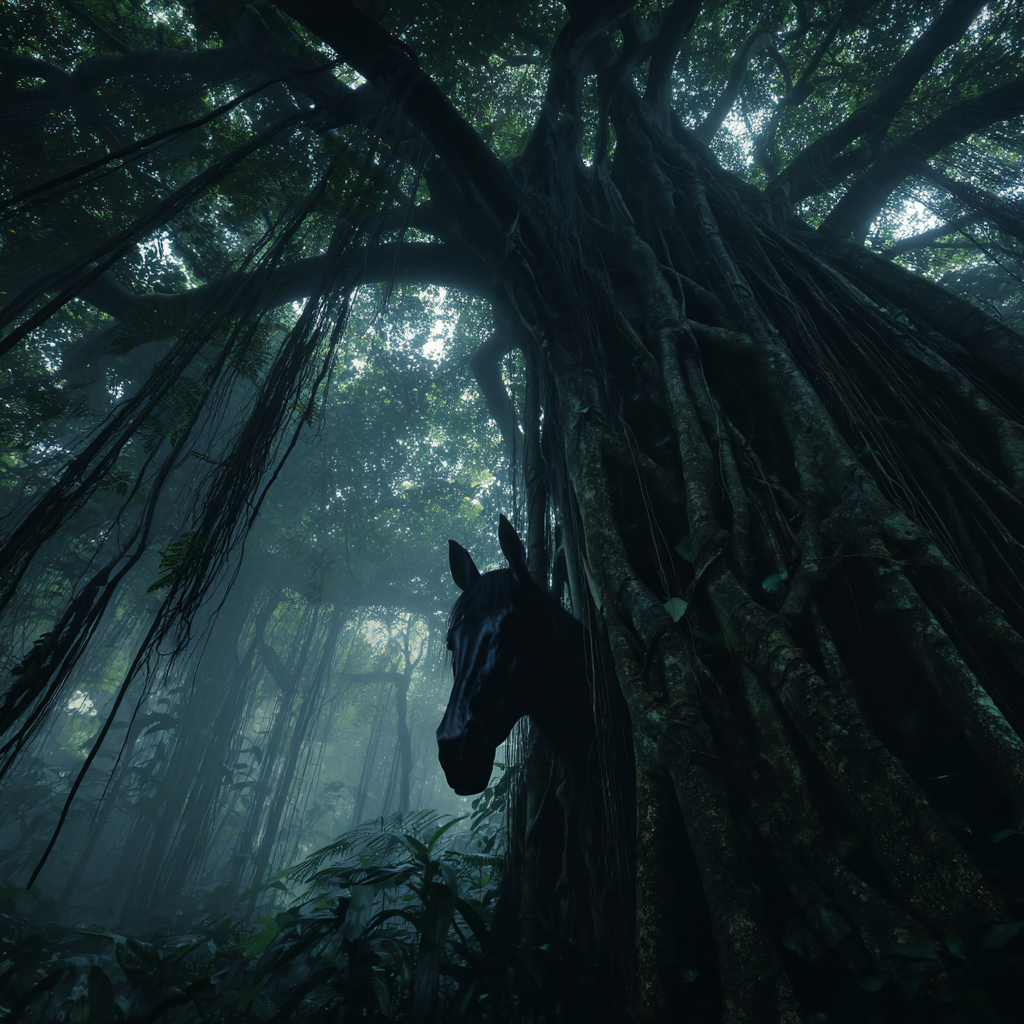
Imagine walking through a dark forest and approaching a Balete tree (a type of ficus or banyan tree). Suddenly, something tall and spindly moves in the shadows.
A figure emerges, the head of a horse atop a human-like body, with limbs so long and disproportionate that when it crouches, its knees rise above its head. Its feet are hooves, and some tales claim these hooves face backward, deliberately tricking people into following the wrong direction and becoming lost.
This is the Tikbalang, a half-human, half-horse creature of Philippine folklore. Unlike the western Centaur, where human and horse forms merge seamlessly, the Tikbalang’s appearance feels unnatural, almost reversed, and ghostly.

The Origins of the Tikbalang
The origins of the Tikbalang stretch deep into pre-colonial Philippines. Early Filipinos believed the world was inhabited by spirits dwelling in forests, rivers, and mountains, places where humans were only visitors, not owners.
Interestingly, horses were not native to the Philippines before colonisation. It is widely believed that the horse-like description of the Tikbalang emerged during Spanish rule, after horses were introduced to the islands.
Before this, the Tikbalang may have been associated with other animals such as goats or serows, creatures that could have inspired its early form through trade or regional contact.
The Tikbalang as a Trickster
The Tikbalang is best known as a mischievous trickster. Travellers who enter forests inhabited by one are said to become hopelessly lost, wandering in endless circles.
The Tikbalang creates illusions, turning even familiar paths into twisted, unrecognisable routes.
There are two commonly known ways to overcome this enchantment. The first is turning your shirt inside out, which is believed to confuse the creature. The second is asking for permission before entering the forest. The phrase often used is ‘Tabi-tabi po’, meaning ‘excuse me’, spoken to show respect to unseen beings.

The Wedding of the Tikbalang
Have you ever seen a heavy downpour while the sun is still shining?
In Philippine folklore, this unusual phenomenon is believed to signal the wedding of two Tikbalangs.

Catching a Tikbalang
One of the most extraordinary beliefs surrounding the Tikbalang is that it can be captured.
Legends say that if a person manages to sneak up on a Tikbalang and pluck three golden hairs from its spiny mane, the creature will be bound to them and forced to obey their commands. But failure means death.
So where might one find a Tikbalang? They are most commonly associated with Balete trees, member of the Ficus genus.
So the next time you find yourself lost in a Philippine jungle and come across a Balate tree, be careful. You may not be alone.
What the Tikbalang Represents
Viewed through a psychological lens, the Tikbalang reflects human fear of the unknown.
Forests are dark, enclosed places where visibility is limited and unfamiliar sounds echo from every direction. For early humans, thick vegetation, shifting shadows, and unexplained noises could easily give rise to fear and imagination.
As stories passed down through generations, these fears became legends. Some individuals, influenced by expectation and vivid imagination, may have believed they saw something supernatural, strengthening belief in the Tikbalang’s existence.
However, not everything can be fully explained by science.
Perhaps, the Tiknalang is one of those mysteries that still exists in the shadows.
So if you ever find yourself wandering through the forests of the Philippines, keep your eyes open, you might just catch a glimpse of one.

Comment below on what Southeast Asian creature you would like to learn more next.
If you are interested in the myths and legends of Southeast Asia, be sure to read Who Are The 37 Fierce & Sacred Nats of Burmese Mythology? Part I
Check out our YouTube channel for videos on the myths & legends of Southeast Asia.
Leave a Reply